
In short
- Write down the meal, how fresh it was, the time, and any symptoms in the next few hours, because histamine levels in the same food can differ hugely
- Test foods one at a time, since lists disagree and no source confirms that eggs, citrus or strawberries are triggers for everyone
- Note the time a reaction started, because MCAS blood and urine tests depend on timing
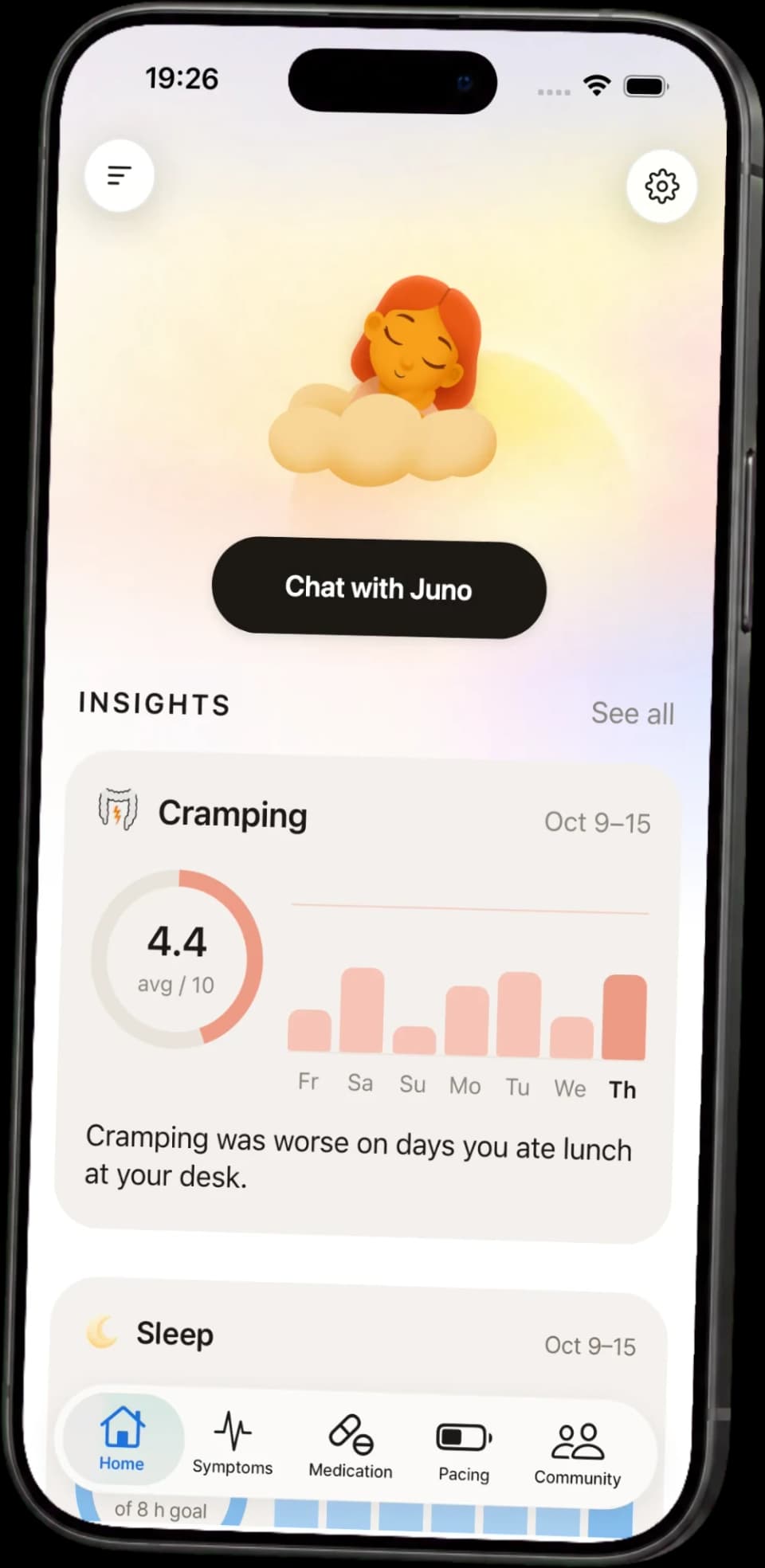
- In Juno you say or type what you ate and how you feel, and she saves it with its date on one timeline
- Juno builds a free patient-generated symptom report you can bring to your doctor or dietitian, so you can show your food notes instead of explaining them from memory
On this page
How Do I Track a Low Histamine Diet for MCAS or Histamine Intolerance?
Keep a food and symptom diary through three phases, and take the notes to a doctor or dietitian. A guideline from German, Swiss and Austrian allergy societies suggests a restriction phase of 10 to 14 days, a test phase of up to six weeks where you add foods back, and then a permanent diet based on your own tolerance.1 The NHS describes the same idea: a short period without the suspect food, then reintroduction after a few weeks to see whether symptoms return, often with a food and symptoms diary.2
If every meal already feels like homework, a diary can start to feel like another job. Juno is built so you don't have to fill in a form. You describe a meal and how you felt afterwards, by voice or text, and she saves it with its date. These are the steps:
- Log what you ate, and how fresh it was. Histamine in food depends on ripeness, storage and processing: the guideline gives Emmental cheese as an example, ranging from under 0.1 to 2,000 mg/kg.1 So "leftover stew, day three" tells you more than "stew".
- Add the time, and the symptoms that follow. In the guideline, only reactions that start between minutes and four hours after eating point towards a food intolerance.1 Say when it started, how bad it was out of 10, and how long it lasted.
- Write down what else was going on. Stress, your period, new medicines, alcohol and pain relief can change how you react. The guideline lists these among the factors that may raise sensitivity to histamine.1
- Change one thing at a time. In the test phase, add back one food, note what happens, then move to the next. Mast Cell Action points out that triggers can be hard to identify and new ones can appear over time, so treat a result as a clue, not a verdict.3
- Look at the pattern with your clinician. Juno puts the entries on one timeline so you can review them as clues, not proof, then bring them to a doctor or a dietitian who knows MCAS.
A made-up day shows how little each entry needs:
| What to Log | Example Entry | Why It Helps |
|---|---|---|
| Meal | Leftover stew, day three | Histamine depends on storage and freshness |
| Time | Ate at 12:30, itching from 13:10 | Food reactions usually start within minutes to four hours |
| Symptom | Flushing and cramps, 6/10, lasted two hours | Severity and length show how big the reaction was |
| Other factors | Day two of period, took ibuprofen, slept badly | These can change how you react |
| Change | Added back tomato on its own | One change at a time keeps the result readable |
For the food list itself, see our low histamine diet guide. This article is about the tracking.
What Foods Calm Down Mast Cells?
No food is proven to calm mast cells. Mast Cell Action frames diet as a way to avoid triggers, including low histamine diets, and suggests help from a dietitian or nutritionist who knows MCAS if it gets complicated.3 The same page lists bioflavonoids such as quercetin and luteolin, and vitamins C and D, as substances that can act as mast cell stabilisers. That is a point to raise with your clinician before you buy a supplement, not a reason to add a food.
Your log can still help here. A food you add back with no reaction over several days is useful information: the NHS warns against cutting foods out without advice from a GP or dietitian, because you could miss vitamins and minerals.2 The aim is a diet with as few restrictions as possible.
What Are High Histamine Foods to Avoid With MCAS?
There is no single list. A 2021 review compared ten published low histamine diets and found they mostly disagreed, with only fermented foods excluded by all of them.4 The foods that usually carry the most histamine are fermented, aged, cured or long-stored: aged cheese, dry-cured sausage, wine and beer, and fish that is not fresh.
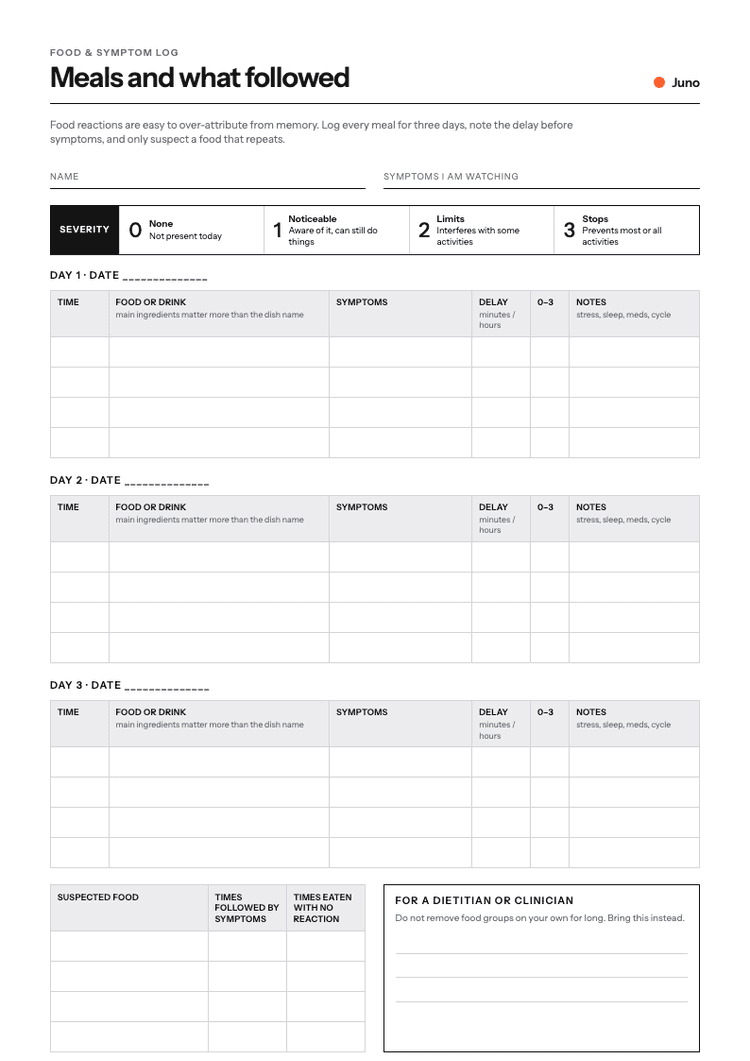
That is why your own log beats a list. Freshness matters as much as the food, so write down how long something sat in the fridge. Alcohol also matters twice: it contains some histamine, and it can slow the breakdown of histamine in the body.1 If you want to tick through foods first, use our printable food list or the free food and symptom log.
Are Eggs a Trigger for MCAS?
For some people they may be, but eggs are not a proven trigger for everyone. In the 2021 review's laboratory data, histamine was not detected in eggs. They still appear on more of the ten diets than most other foods without histamine, alongside chocolate, strawberry, pineapple and yogurt.4
Some foods are on lists because they are said to make the body release its own histamine. The guideline says there is no reliable evidence that such "histamine liberators" exist in foods.1 So an egg is a food to test, not to ban on a hunch. Add it back on its own, log the next four hours, and see what your own diary says. If you had a severe reaction after an egg or any food, that is a question for an allergist, not for a diary.
What Calms a MCAS Flare?
In an acute episode with symptoms like swelling, breathing trouble or fainting, the answer is emergency treatment, not a diet. The American Academy of Allergy, Asthma & Immunology says acute episodes should be treated like anaphylaxis, starting with epinephrine if the severity calls for it.5 In the UK, the NHS says to call 999 if your lips, mouth, throat or tongue suddenly swell, you struggle to breathe or swallow, your skin turns blue, grey or pale, you become very confused or drowsy, or someone faints and cannot be woken.2 In the US, call 911.
For milder episodes, your plan comes from your own doctor. The AAAAI lists antihistamines, histamine type 2 blockers such as famotidine, and other medicines that an allergist may use, each for different symptoms.5 Which one is right for you, and how much, is for your clinician to say.
Logging helps afterwards. The AAAAI says mast cell tryptase should be drawn between 30 minutes and two hours after the start of an episode, so the time your reaction began is worth noting.5 Juno is not an emergency service and cannot tell you what to take. This is general information, so ask your clinician about your own plan.
Can MCAS Turn Into Leukemia?
We found no source that says MCAS turns into leukemia, but a different, rare mast cell condition does need to be ruled out. The AAAAI describes mastocytosis as a clonal mast cell disorder, and mast cell leukemia as a very rare form of it with a difficult prognosis.6 When doctors diagnose MCAS, the AAAAI says further tests should rule out these clonal disorders, with a blood test for the KIT D816V mutation and, if indicated, a bone marrow biopsy.5
If this fear sits behind your reading, say so at your appointment. A food diary cannot diagnose or rule out any of this. What it can do is give your allergist a clear account of how often you react, how long it lasts and what came before.
How Juno Handles This
Juno is a 24/7 health assistant for people living with chronic illness, and she is where your food notes and your symptoms meet. You talk or type to Juno, and she saves each symptom with its date and, when you mention them, how severe it was, where you felt it, what you think set it off and how long it lasted. She looks at your chat alongside sleep, activity and wearable data, plus weather, temperature and pollen, to help you notice what changes together. These are clues to explore with your care team, rather than proof of a cause.
What people say about logging with Juno
★★★★★App Store
Explain it out loud
“Works great at helping me keep track of my symptoms and concerns to bring up with for doctors appointments and my favorite part is that I can do an audio conversation with it and explain certain pains or symptoms that I’m feeling and Juno will help explain the medical term for the pain I’m explaining so that the doctors can better understand.”
App Store review, US · October 2026
★★★★★App Store
One page for the doctor
“Having all the data compiled into a single page PDF to bring with to my doctors appointments is extremely beneficial for tracking my chronic illness.”
App Store review, US · October 2026
★★★★★App Store
Knowing what to ask
“Juno helps knowing what to advocate for, the questions and tests that can keep the conversation moving.”
App Store review, US · October 2026
Quoted as written from public App Store reviews.
When an appointment comes, Juno turns the timeline into a patient-generated symptom report you can review, then email or print as a PDF. There is no doctor portal yet, so you choose what to share. Symptom tracking, pacing, health insights and doctor reports are free on iOS and Android; the optional paid plan adds unlimited AI chat and enhanced memory. Juno supports self-management and clinic preparation. She doesn't diagnose, and she is not a medical device.
Download Juno, tell her what you ate today, and see what the next two weeks show. You can see what a report looks like first in the sample report, or start with the MCAS symptom tracker.
Frequently asked questions
What Is the Best Way to Keep a Food Diary for MCAS?
Log what you ate, how fresh it was, the time, and any symptoms in the next few hours. In Juno you can say or type this in a sentence, and she keeps the details you mention. Ask your doctor or dietitian how to use it.
How Long Should I Follow a Low Histamine Diet for MCAS?
A guideline from German, Swiss and Austrian allergy societies suggests 10 to 14 days of cutting back, then up to six weeks of adding foods back one at a time. It is meant to end with as few restrictions as possible, with a doctor or dietitian guiding you.
What App Can I Use to Track MCAS Reactions and Triggers?
Juno lets you log MCAS reactions by text or voice, including what you ate and what you think set it off. She puts them on one timeline and can turn them into a free symptom report. Juno does not diagnose MCAS or confirm a trigger.
Do I Need a Diagnosis to Track a Low Histamine Diet in Juno?
No. You can log symptoms and meals while you work with your clinician toward answers. Juno doesn't diagnose conditions or tell you what your symptoms mean.
Juno features mentioned in this article
Sources
- Reese I et al. Guideline on management of suspected adverse reactions to ingested histamine. Allergologie Select 2021
- NHS: Food intolerance
- Mast Cell Action: Management
- Sánchez-Pérez S et al. Low-histamine diets: is the exclusion of foods justified by their histamine content? Nutrients 2021
- AAAAI: Mast Cell Activation Syndrome (MCAS)
- AAAAI: Systemic mastocytosis
Turn day-to-day notes into a clearer health story
Juno helps you track symptoms through conversation, notice patterns, and prepare a structured summary for appointments. Explore symptom tracking in Juno.


This article is for general information only and does not replace advice from your own clinician. Juno is a health assistant, not a medical provider.