
In short
- Your own record of meals and symptoms over weeks beats any home food sensitivity test
- Take one suspect food out for a few weeks, then bring it back, with a dietitian's help
- Get tested for coeliac disease before you cut out gluten, and keep eating it until then
- Juno shows you which foods tend to trigger your symptoms, from the meals and symptoms you log by voice or text
- Juno turns your diary into a free patient-generated symptom report for your doctor
On this page
How Do I Find Out Which Foods Make My Symptoms Worse?
Start with a food and symptom diary, then test what it shows. Bloating, cramps or a headache after eating are easy to blame on the last thing you ate. A food intolerance usually causes symptoms a few hours later, and they can last hours or days.1 A food allergy can react straight away or days later.2 Memory can't hold that.
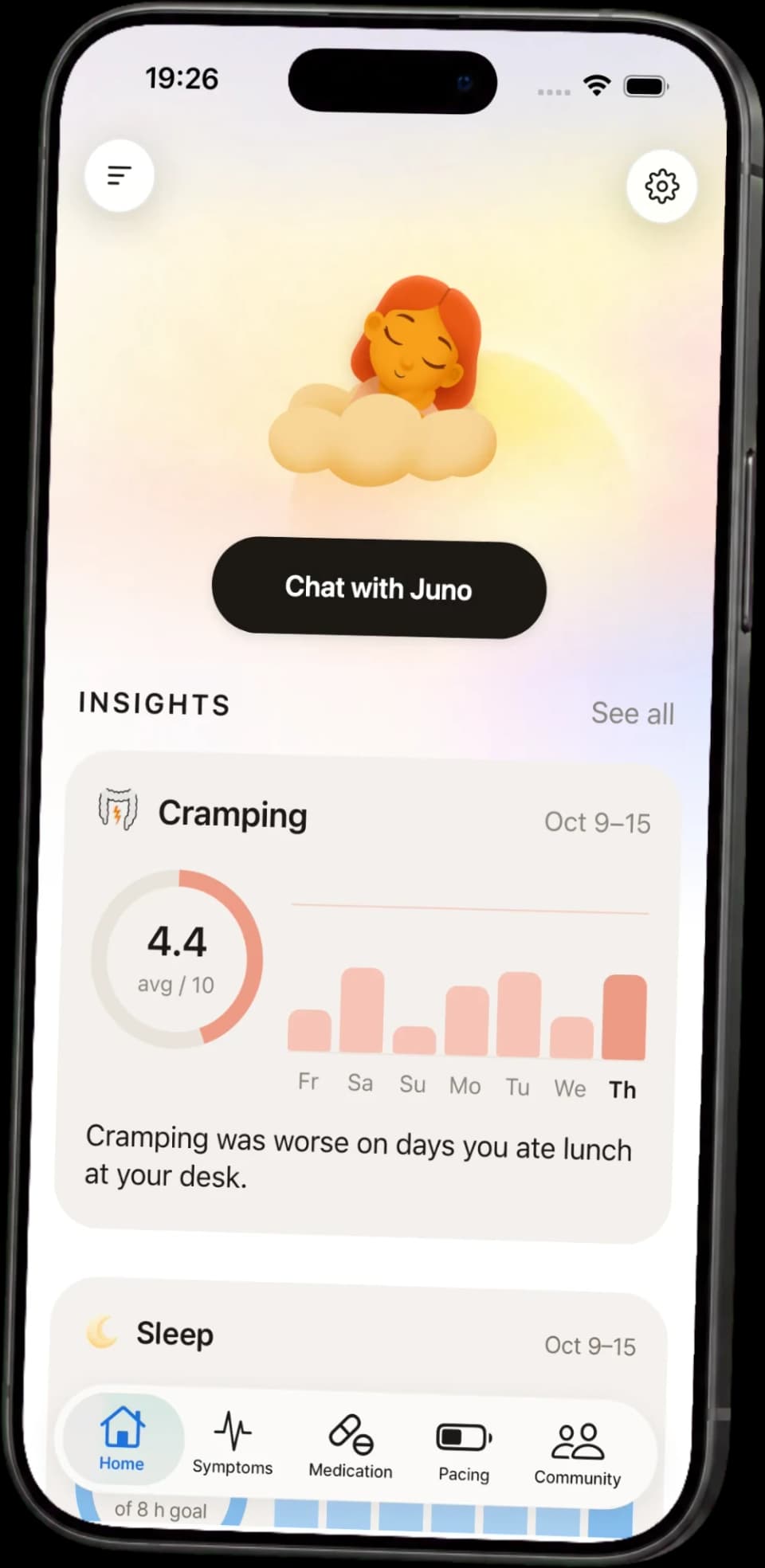
Juno can keep that diary for you, as shown below. The usual route has three steps:1
- Keep a food and symptom diary for a few weeks: every meal, snack and drink, and every symptom with its time and severity
- Take the diary to a GP (UK) or your doctor (US). If they think it's an intolerance, they may refer you to a dietitian
- Try a supervised elimination diet. You avoid one suspect food for a few weeks, then eat it again to see if your symptoms come back
The British Dietetic Association (BDA) says a food intolerance needs a detailed history taken by an experienced health professional.3 Your diary gives them that history. Don't cut foods out on your own: the NHS warns you could miss out on vitamins and minerals, which matters most for children.1
If you have IBS, the dietitian route is usually the low FODMAP diet, covered in our IBS food diary guide.
What to Write in a Food and Symptom Diary
Write down enough that someone else could rebuild your day. For each entry, note:
| Entry | What to write |
|---|---|
| Meal | What you ate and drank, roughly how much, and the time |
| Symptom | What you felt, where, and how bad from 0 to 10 |
| Timing | When it started and how long it lasted |
| Context | Sleep, stress, your cycle, medicines, exercise |
The context row matters because food isn't the only trigger. A flare up after a short night or a stressful day can look like a food reaction. Note days with no symptoms too, so a pattern can show up and not just the bad days.
A hypothetical example: you note cramping and bloating at about a 6, three hours after a cheese toastie. After two weeks, it has happened on 3 of the 5 days you had dairy, and on none of the days without it. That's a clue to discuss, not a diagnosis. It's also the difference between a diary and a symptom checker: a checker guesses at a cause, a diary records yours.
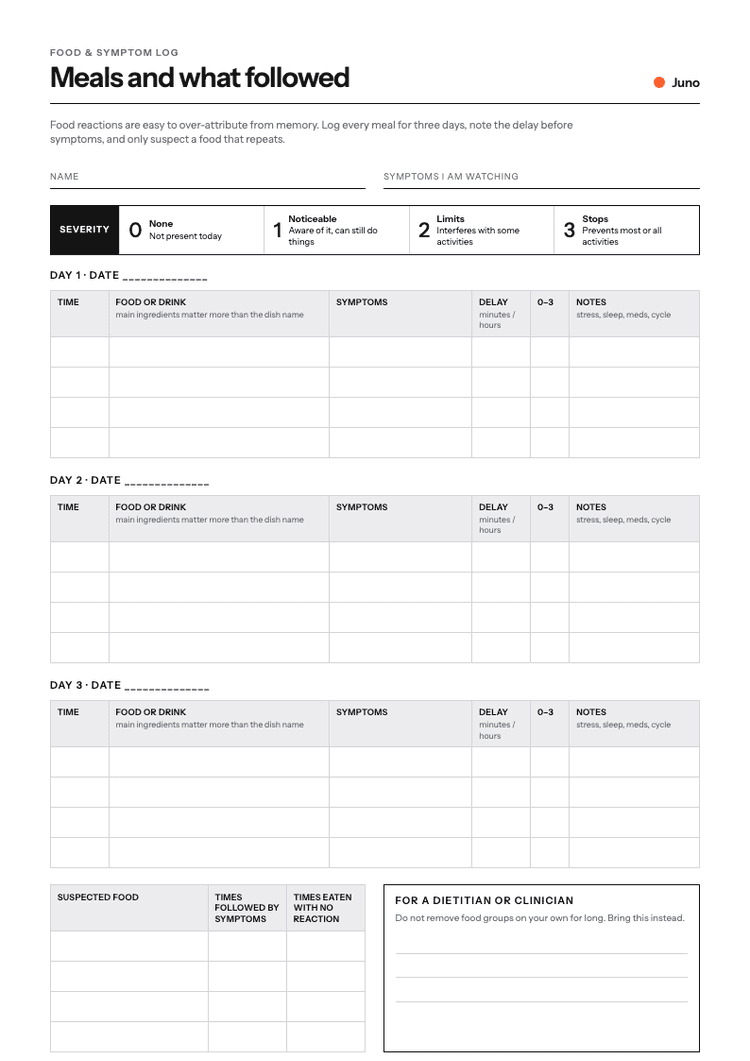
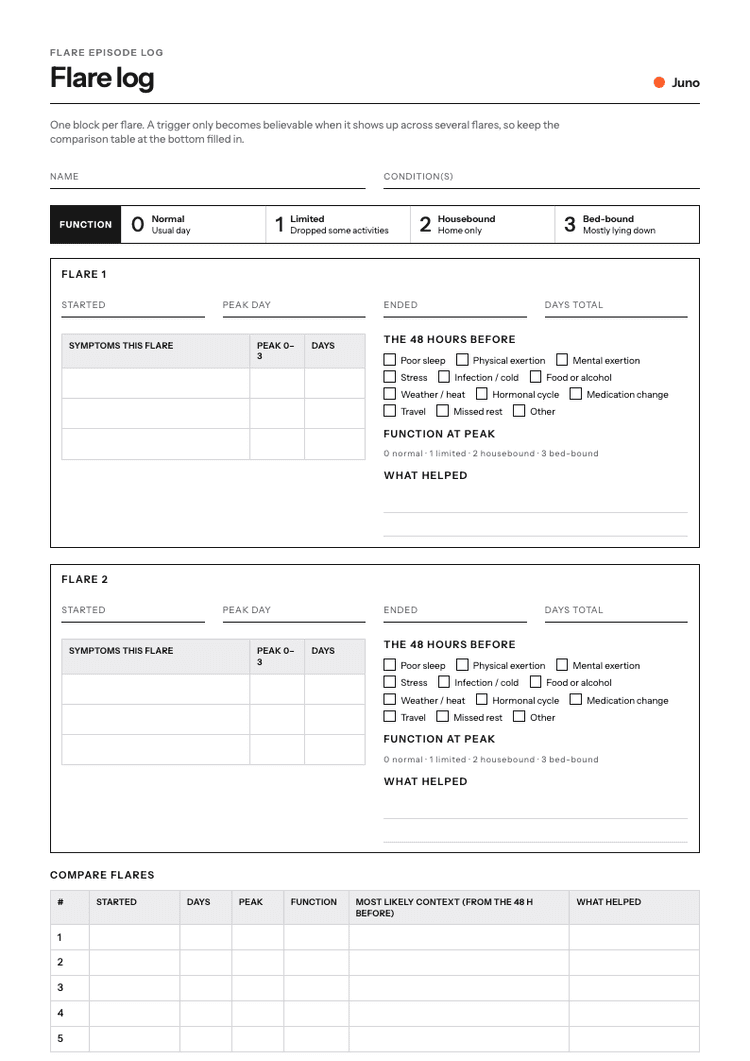
Prefer paper? Print our free food and symptom log.
How to Find Your Food Triggers With Juno
Juno is a free AI health assistant for people living with chronic illness, including IBS and MCAS. Juno makes a food and symptom diary easy to keep, even on a bad day, because you talk instead of filling in a form.
Tell Juno what you ate and how you feel in your own words, like the cheese toastie in the example above. She saves the symptom with its date. When you mention them, she also saves how bad it was, what you think set it off and how long it lasted. Each meal gets its own entry in Juno's Food section, where you mark how you felt after eating.
How it looks in Juno
Marking how you felt after a meal
- 01Your meal, with the timeYou see what you ate and when, here a cheese toastie at 14:00.
- 03Add what else happenedTap Bloated, Tired after, Heartburn or Nauseous, and note when it started.
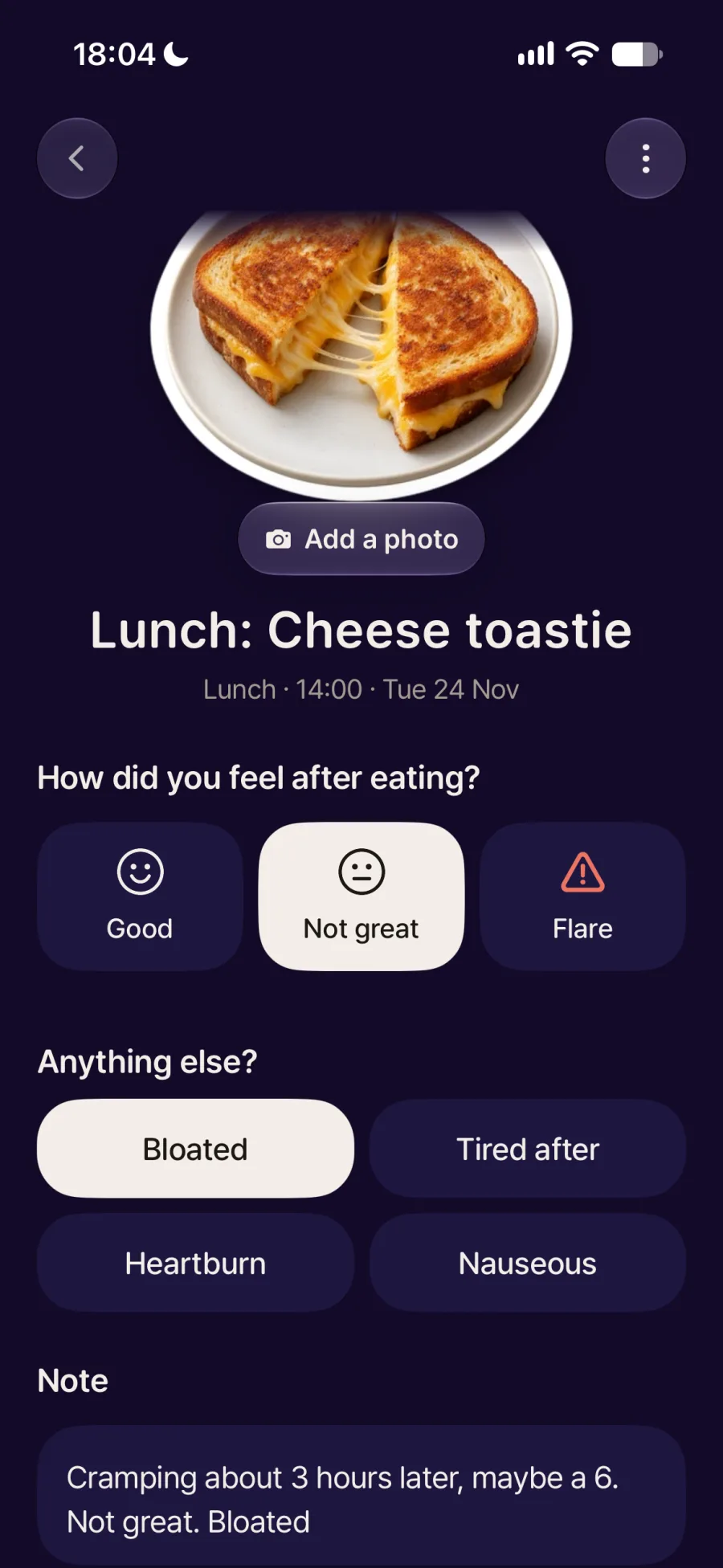
- 02Say how you felt after eatingPick Good, Not great or Flare.
- 01Your meal, with the timeYou see what you ate and when, here a cheese toastie at 14:00.
- 02Say how you felt after eatingPick Good, Not great or Flare.
- 03Add what else happenedTap Bloated, Tired after, Heartburn or Nauseous, and note when it started.
Over the weeks, Juno shows you which foods tend to trigger your symptoms. She looks at what changes together across your meals, symptoms, sleep, weather, pollen and data from more than 20 wearables and health platforms, so a short night or a stressful day doesn't get blamed on lunch. Take what Juno finds to your doctor or dietitian as clues to test. Juno doesn't diagnose intolerances, so cut foods out only with their help.
After 7 days with data, Juno can turn your entries into a patient-generated symptom report. You export it as a PDF and choose who sees it (example report). Symptom tracking, health insights and doctor reports are free in Juno.
What people say about tracking with Juno
★★★★★Google Play
Just talk and it logs
“I have always wanted to track and figure out my symptoms with chronic pain and Illness but having to write it down myself and figure it all out made me give up. Even just logging my food or what symptoms happened after was too much. But with Juno you just talk and it logs everything.”
Google Play review · October 2026
★★★★★App Store
One page for the doctor
“Having all the data compiled into a single page PDF to bring with to my doctors appointments is extremely beneficial for tracking my chronic illness.”
App Store review, US · October 2026
★★★★★App Store
Patterns you can show
“This has genuinely changed my life, being able to take concrete data to doctors appointments, being able to track patterns in symptoms …”
App Store review, US · May 2026
Quoted as written from public App Store and Google Play reviews.
Download Juno and log today's lunch and how you felt after it.


Is a Food Sensitivity Test Reliable?
No. Home food sensitivity tests, usually IgG blood panels that test 90 to 100 foods, have never been scientifically proven to do what they claim. The American Academy of Allergy, Asthma & Immunology (AAAAI) says IgG is likely a normal response to eating a food. Higher levels may even go with tolerating it.4
The AAAAI and the Canadian Society of Allergy and Clinical Immunology recommend against IgG tests for diagnosing food allergies or intolerances. No single test can tell you exactly which foods to avoid.4
Before you change your diet a lot, see a doctor or an allergist.
Which 8 Foods Cause 90% of Food Allergies?
In the US, 8 foods were named as major allergens in 2004: milk, eggs, fish, crustacean shellfish, tree nuts, peanuts, wheat and soybeans. At the time, they caused 90% of food allergies and serious allergic reactions in the US. Sesame became the ninth on 1 January 2023, so US food labels now list 9.5
In the UK, food businesses must declare 14 allergens. These are celery, cereals containing gluten, crustaceans, eggs, fish, lupin, milk, molluscs, mustard, peanuts, sesame, soybeans, sulphites and tree nuts.6
These lists are about allergies, where the immune system reacts. Many people looking for their food triggers have an intolerance instead, which works differently. The AAAAI says many people with an intolerance can eat small amounts without a problem. With an allergy, even a tiny amount can cause a serious reaction.7
Does the NHS Recommend Food Intolerance Tests?
The NHS doesn't recommend the food intolerance tests you can buy. It says there's limited evidence that they give accurate results. They may also tell you to avoid several foods, which can be harmful.1
Instead, see a GP if your symptoms keep coming back.1 In the US, the same advice comes from your doctor or an allergist.7
Are There Food Intolerance Tests That Actually Work?
Yes, for specific conditions, ordered by a doctor:
- Lactose intolerance: a hydrogen breath test measures how well you digest lactose. A GP may also suggest a lactose elimination diet or blood tests8
- Coeliac disease: a blood test, confirmed by a specialist. Keep eating gluten while you're tested, or the result can be wrong, and don't start a gluten-free diet before the diagnosis is confirmed9
- Food allergy: a skin-prick test or blood tests, run by a specialist2
For most other intolerances, the test is the elimination diet with reintroduction from the first section.
What Are the 5 Most Common Food Intolerances?
There's no official top 5, but the NHS names lactose intolerance as the most common food intolerance.1 These five come up often:
| Intolerance | Found in |
|---|---|
| Lactose | Milk, cheese, yoghurt |
| Gluten | Bread and pasta made with wheat, rye or barley |
| Histamine | Wine, cheese and other aged or preserved foods |
| Caffeine | Coffee, tea, some fizzy drinks |
| Sulphites | Cider, beer, wine |
The NHS also lists alcohol, salicylates in some fruits, vegetables, herbs and spices, monosodium glutamate (MSG) and benzoates.1 The BDA adds tuna, mackerel, pork products and tomatoes to the histamine foods.3 Our low histamine diet guide and MCAS symptom diary go further.
When Is a Reaction to Food an Emergency?
A food intolerance can't cause a serious allergic reaction, but a food allergy can.12
If you have an adrenaline auto-injector, use it straight away, then call 999 or 911, even if you feel better.2 See a doctor about new symptoms after eating. Juno is not an emergency service.
Frequently asked questions
What foods trigger IBS?
It differs from person to person, which is why a diary matters. The NHS names spicy or fatty food, alcohol and caffeine, and also stress and anxiety. A dietitian can guide you through the low FODMAP diet.
How long should I keep a food diary?
Long enough to cover good and bad days and several meals with each food you suspect. Keep it going through the elimination diet and reintroduction too.
Can a food intolerance cause symptoms outside the gut?
Yes. The NHS lists headaches, tiredness, joint pain and rashes as possible symptoms, not just bloating and tummy pain.
What should I tell my doctor about food reactions?
Bring your diary, plus any foods you've already cut out and for how long. Mention allergies, asthma or eczema in you or close family, which make a food allergy slightly more likely.
Juno features mentioned in this article
Sources
- NHS: Food intolerance
- NHS: Food allergy
- British Dietetic Association: Food allergy and food intolerance (Food Fact Sheet)
- AAAAI: The myth of IgG food panel testing
- U.S. Food and Drug Administration: Food allergies
- Food Standards Agency: Allergen guidance for food businesses
- AAAAI: Food intolerance versus food allergy
- NHS: Lactose intolerance
- NHS: Coeliac disease, diagnosis
Turn day-to-day notes into a clearer health story
Juno helps you track symptoms through conversation, notice patterns, and prepare a structured summary for appointments. Explore Juno’s IBS symptom tracker.
This article is for general information only and does not replace advice from your own clinician. Juno is a health assistant, not a medical provider.