
In short
- Write each entry close to the meal, not from memory at night
- Change one thing at a time, so your diary can show what actually helped
- Keep the diary through all 3 low FODMAP steps, so you end up avoiding as few foods as possible
- In Juno, log meals and symptoms together and mark a meal that came before a flare up
- Juno puts meals and symptoms on one timeline and turns them into a free doctor report
On this page
How Do You Keep a Food and Symptom Diary for IBS?
To keep an IBS food diary, write down everything you eat and drink, when you had it and roughly how much. Then note any gut symptoms in the hours that follow and how bad they were. Keep it for 2 to 4 weeks before you change anything, so you have a baseline to compare against.
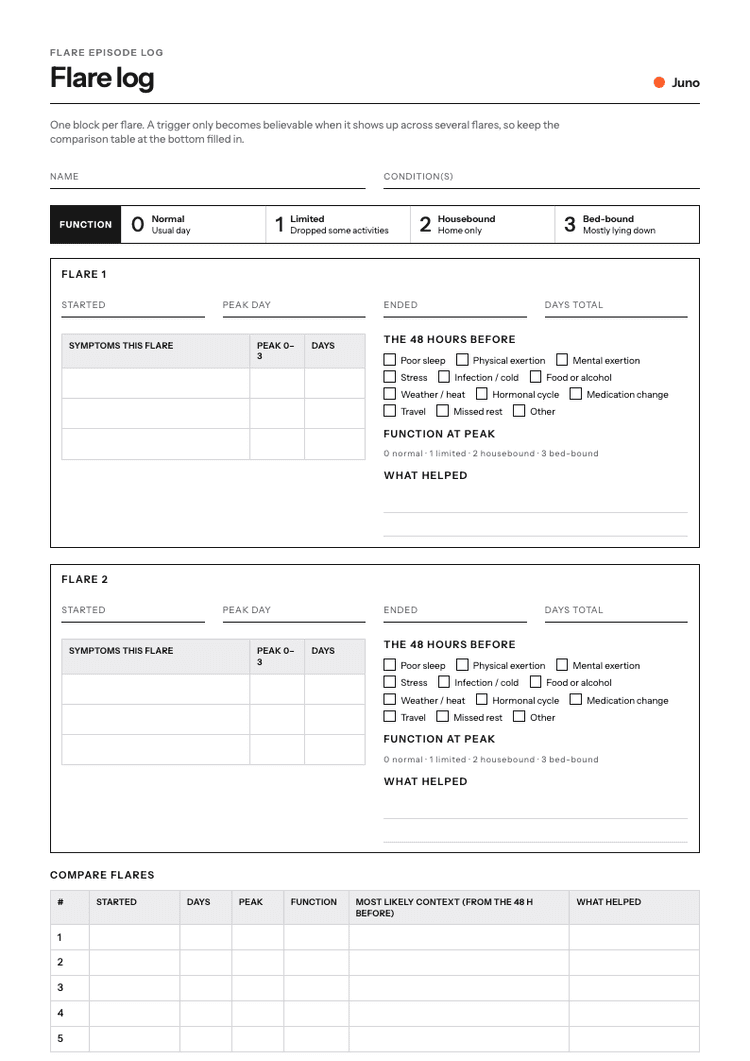
The NHS advises people with IBS to keep a diary of what they eat and any symptoms they get, and to avoid what triggers them.1 If you were looking for an NHS symptom tracker for IBS, that diary is the method. The British Dietetic Association (BDA) adds two rules that make it work: keep the diary while you make changes, and make one change at a time.2
That sounds like a lot when your gut already takes up half your day. It gets easier if you write each entry close to the meal, in a few words, instead of rebuilding the day from memory at night. A food diary is not a symptom checker: it won't tell you what you have, but it gives your dietitian or doctor something concrete.
What Should an IBS Food Diary Include?
An IBS food diary needs the food side and the symptom side on the same page. Log these each time:
- What you ate and drank, with the main ingredients and a rough amount
- When, including whether you ate quickly or skipped a meal
- Abdominal pain or cramping, rated 0 to 10
- Bloating and gas
- Your bowel habit: how often, and the type on the Bristol stool chart
- Stress, sleep and your period, because they can change symptoms too
- What it changed in your day, like leaving work early or skipping plans
One illustrative entry:
| Time | Food and drink | Symptoms after | Context |
|---|---|---|---|
| 12:40 | Tuna salad sandwich with red onion and garlic dressing on wheat bread, apple, coffee | Cramping 6/10 and bloating at 13:45, loose poo at 16:00 | Ate at desk in 10 minutes, poor sleep |
The NHS lists alcohol, caffeine, spicy or fatty food, stress and regular antibiotic use among possible triggers.3 So a rushed lunch after a bad night is not the same test as that food on a calm day.
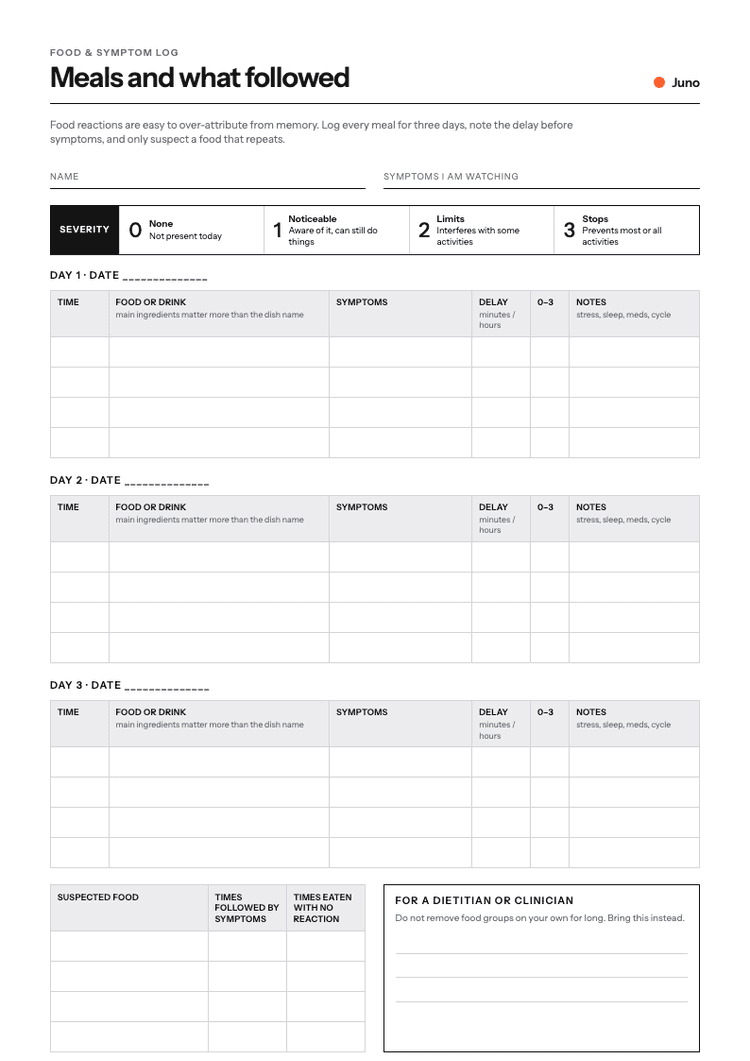
If you prefer paper, our free food symptom log gives you three days of meals, delays and severity on one printable sheet.
What Is the Best Free Food Diary App for IBS?
The best free food diary app for IBS records meals and gut symptoms in one place and is quick enough for a bad day. A notes app works, but it won't line foods up with symptoms.
Juno, our app for people living with chronic illness including IBS, does both, and its symptom tracking and doctor reports are free, according to Juno's FAQ. For a wider comparison, see our guide to the best symptom tracker apps.
How to Keep Your IBS Food Diary With Juno
Juno works like an IBS tracker you talk to. Tell her what you ate and how you feel, by voice or text, in your own words, and she logs it, so you don't have to fill in a form.
How it looks in Juno
Logging a meal and how you feel in one message
- 02Juno repeats what you loggedCheck that the meal and the rating match what you meant.
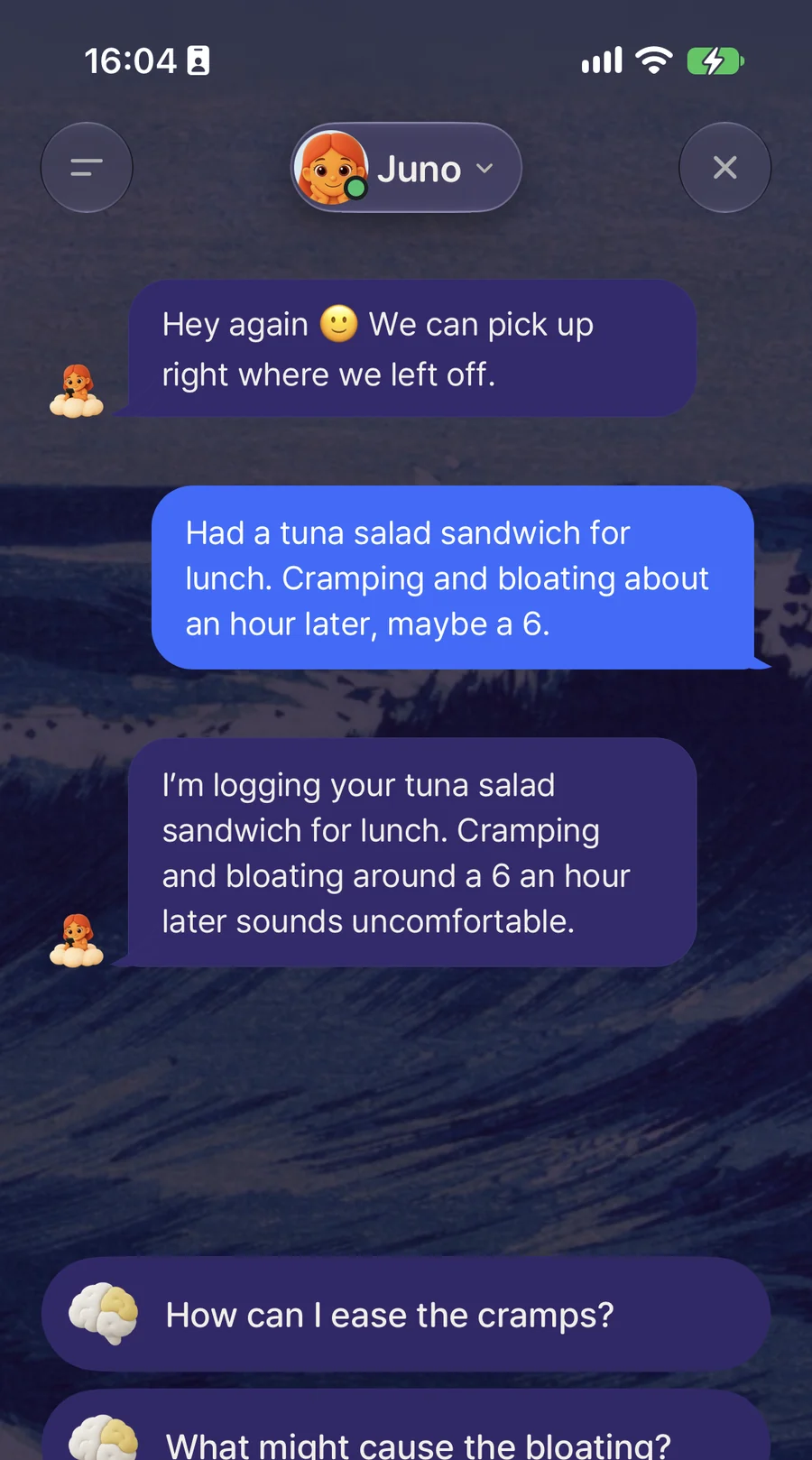
- 01Say what you ate and how you feelThe meal, the symptom, when it started and how bad it is, in one message.
- 03Ask a follow-upTap a suggested question, like what might cause the bloating.
- 01Say what you ate and how you feelThe meal, the symptom, when it started and how bad it is, in one message.
- 02Juno repeats what you loggedCheck that the meal and the rating match what you meant.
- 03Ask a follow-upTap a suggested question, like what might cause the bloating.
Each meal also gets its own entry in Juno's Food section, where you mark how you felt after eating.
How it looks in Juno
Marking how you felt after a meal
- 01The meal, with time and dateYou see what you ate and when, here a tuna salad at 15:44.
- 03Say how badMild, moderate or severe.
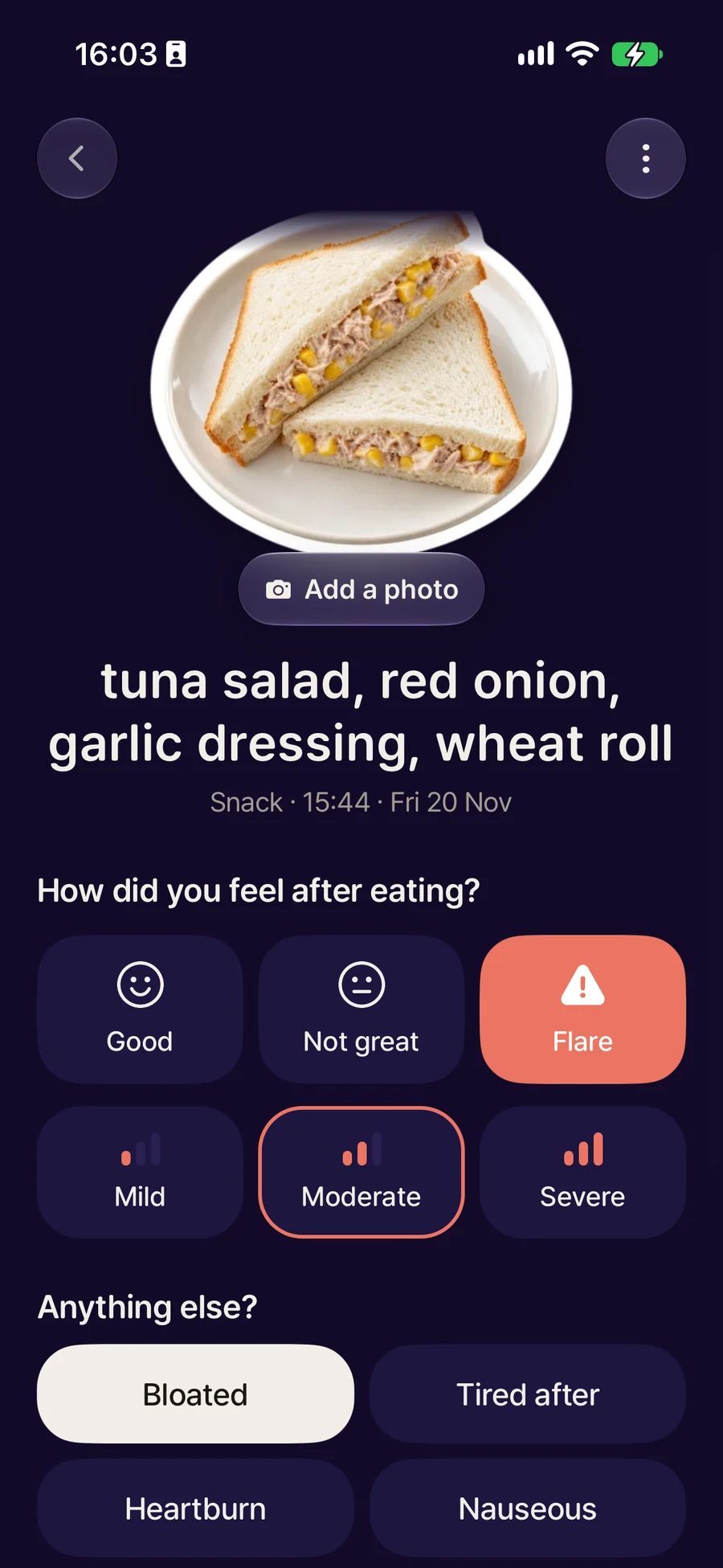
- 02Mark a flarePick Good, Not great or Flare under How did you feel after eating?
- 04Add what else happenedTap Bloated, Tired after, Heartburn or Nauseous.
- 01The meal, with time and dateYou see what you ate and when, here a tuna salad at 15:44.
- 02Mark a flarePick Good, Not great or Flare under How did you feel after eating?
- 03Say how badMild, moderate or severe.
- 04Add what else happenedTap Bloated, Tired after, Heartburn or Nauseous.
Over the day, the Food section becomes your diary. Juno looks at what changes together across your meals, symptoms, sleep and data from more than 20 wearables and health platforms. Treat any pattern as a clue to explore with your dietitian or doctor, not proof of a cause. It can just as easily come from stress or a short night.
How it looks in Juno
Your food diary for the day
- 02Flare or delete with a swipeSwipe an entry to mark a flare after the fact.
- 04Drinks on the same pageWater, caffeine and alcohol sit next to your meals.
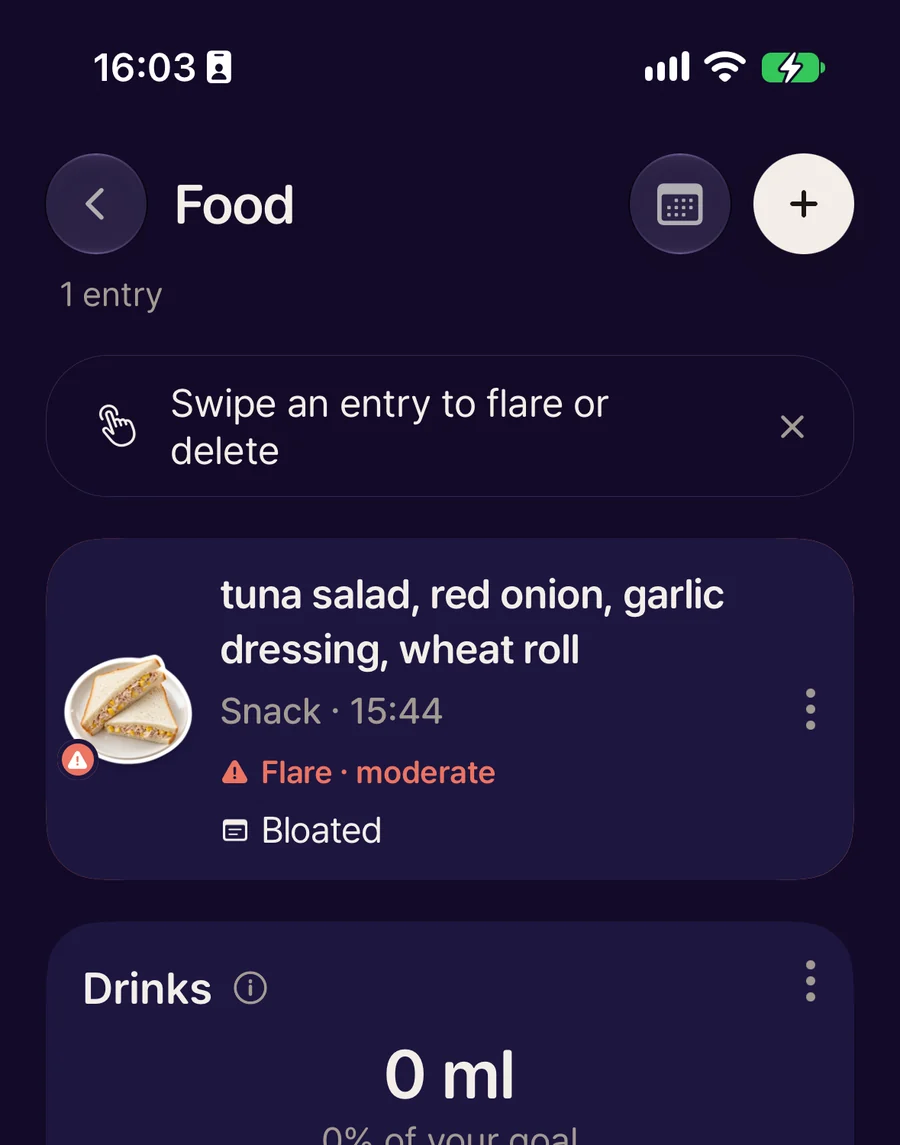
- 01Add the next mealTap + to dictate it, take a picture, tell Juno or add it by hand.
- 03Every meal on one listEach entry shows the time, any flare and what you noticed.
- 01Add the next mealTap + to dictate it, take a picture, tell Juno or add it by hand.
- 02Flare or delete with a swipeSwipe an entry to mark a flare after the fact.
- 03Every meal on one listEach entry shows the time, any flare and what you noticed.
- 04Drinks on the same pageWater, caffeine and alcohol sit next to your meals.
After 7 days with data, Juno can turn your entries into a patient-generated symptom report you can export as a PDF. You choose who sees it. There is no doctor portal. See the example report for the format.
How it looks in Juno
What the report looks like
- 01The period it coversWho it is for, the report period and how many days have entries.
- 02What changed, in numbersShort findings with days, ratings and dates.
- 03Each symptom at a glanceHow many days, the average and the worst rating.
- 04Questions to bringPoints to discuss, built from what you logged.
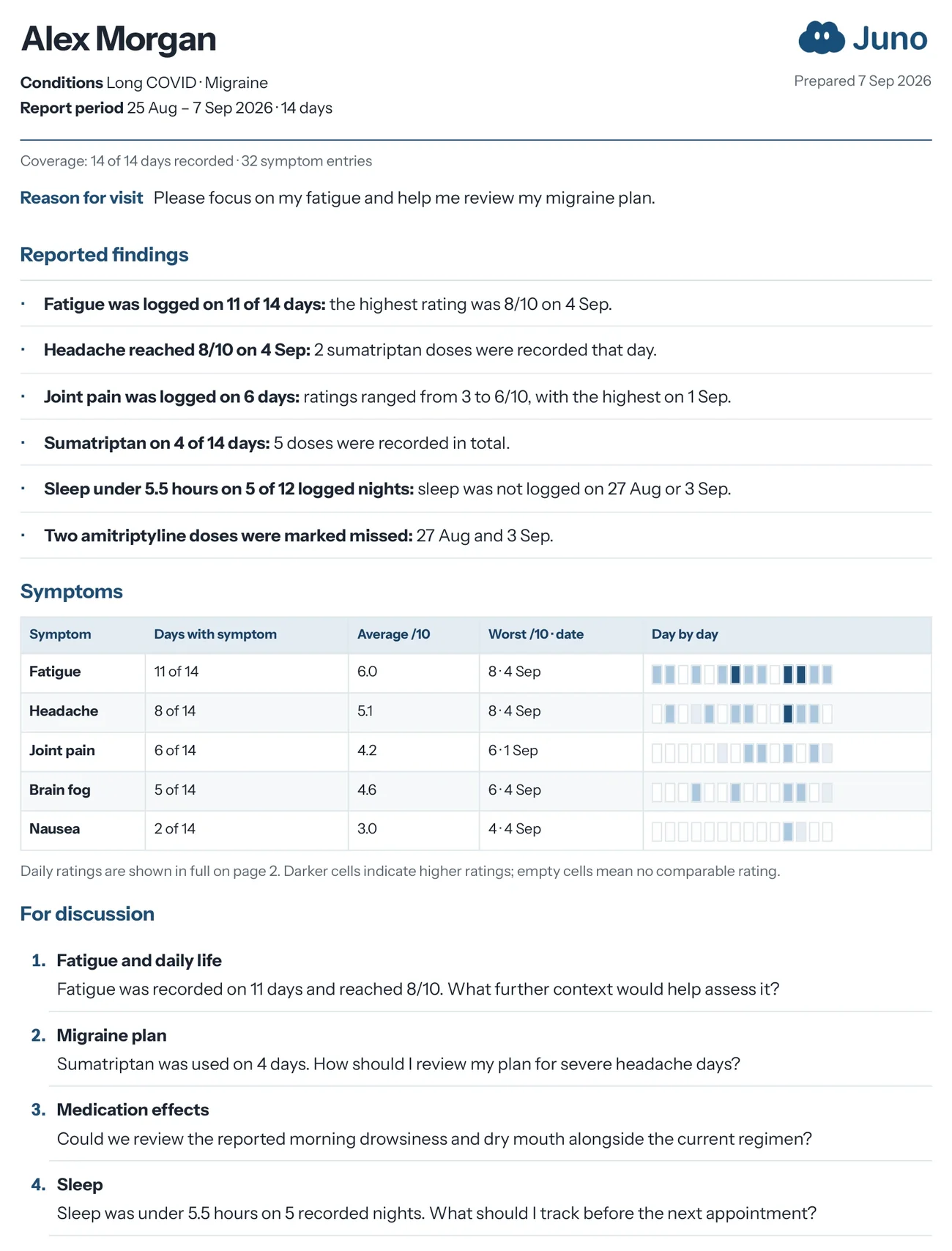
- 01The period it coversWho it is for, the report period and how many days have entries.
- 02What changed, in numbersShort findings with days, ratings and dates.
- 03Each symptom at a glanceHow many days, the average and the worst rating.
- 04Questions to bringPoints to discuss, built from what you logged.
Juno doesn't diagnose, check FODMAP content or replace a dietitian. She holds the record, so you don't have to keep the whole picture in your head. Download Juno and start your diary with today's lunch.
What people say about tracking with Juno
★★★★★App Store
The chat is the best part
“I’ve been using this for a couple weeks and found it to be very helpful. … The best part is the chat/voice AI feature.”
App Store review, US · October 2026
★★★★★App Store
Easy to keep up
“This app is really helpful in managing my symptoms. It’s great and super stupid easy for tracking.”
App Store review, US · November 2026
★★★★★App Store
One page for appointments
“Having all the data compiled into a single page PDF to bring with to my doctors appointments is extremely beneficial for tracking my chronic illness.”
App Store review, US · October 2026
Quoted as written from public App Store reviews.
What Foods Should You Avoid With IBS?
No single list fits everyone with IBS, which is exactly why the diary matters. These are the foods and drinks the NHS and BDA most often suggest cutting down on:12
- Fatty, spicy and processed food, such as chips, fast food and ready meals
- Gas-producing vegetables and pulses, like cabbage, broccoli, cauliflower, Brussels sprouts, beans and onions, if bloating is your main symptom
- Sweeteners such as sorbitol, found in sugar-free sweets, mints and gum
- More than 3 caffeinated drinks a day, plus lots of alcohol or fizzy drinks
- More than 3 portions of fresh fruit a day, where a portion is 80 g
Try these simple changes before a full low FODMAP diet. The BDA notes that sometimes they are all that is needed.2
What Foods Calm an Irritable Bowel?
For bloating, cramps and gas, the NHS suggests eating oats, such as porridge, regularly and up to 1 tablespoon of linseeds a day.1 The BDA suggests a small glass of fluid (about 150 ml) with each tablespoon of linseeds.2
For constipation, the NHS suggests more soluble fibre, from oats, pulses, carrots, peeled potatoes and linseeds, plus plenty of water. For diarrhoea, it suggests cutting down on high-fibre foods like wholegrains, nuts and seeds.1 The NIDDK, part of the US National Institutes of Health, also finds soluble fibre more helpful than other fibre, and advises adding it slowly to avoid gas.4
How Does a Food Diary Work With the Low FODMAP Diet?
If simple changes aren't enough, the low FODMAP diet is where the diary does its most useful work. FODMAPs are carbohydrates that are hard to digest, found in foods like apples, onions, garlic, beans, milk, wheat and honey.4 Monash University describes its Low FODMAP Diet in 3 steps:5
- Swap. Replace high FODMAP foods with low FODMAP ones for 2 to 6 weeks. Your diary shows whether symptoms improve
- Reintroduce. Eat a food rich in one FODMAP group daily for 3 days and record how you tolerate it. Your diary is the result of each challenge
- Personalise. Bring back everything you tolerate and limit only what triggers symptoms, at a level that gives relief
According to Monash, about 3 in 4 people with IBS improve on the diet, and about 1 in 4 do not and need other treatments.5
For the reintroduction step, a simple log keeps each challenge apart. This one is illustrative:
| Days | FODMAP group | Test food | Symptoms (0–10) | Verdict |
|---|---|---|---|---|
| 1–3 | Lactose | Milk | Bloating 2, no change in bowel habit | Tolerated |
| 4–6 | Fructose | Honey | Cramping 5, loose poo on day 2 | A trigger at this amount |
Both Monash and the BDA say to do the diet with a dietitian.2 Ask your GP for an NHS dietitian referral in the UK, or your doctor for a registered dietitian in the US. The NHS also says to see a GP if you find you need to avoid lots of different foods to control your symptoms.1
Which Probiotic Is Best for IBS?
There is no single best probiotic for IBS. UK guidance doesn't name one. NICE advises taking any probiotic you choose for at least 4 weeks at the manufacturer's dose while you monitor the effect.6 The BDA says to try one product at a time, and to switch brands if it doesn't help.2 In the US, talk to your doctor before you start one.
Note the day you start, keep everything else steady, and compare your diary before and after 4 weeks.
When Should You See a Doctor About IBS Symptoms?
See a GP if you think you have IBS and have had symptoms for more than 4 weeks. They can check for IBS and rule out other problems.3
Ask for an urgent GP appointment or get help from NHS 111 if you:3
- Have lost a lot of weight for no reason
- Are bleeding from your bottom or have bloody diarrhoea
- Find a hard lump or swelling in your tummy
- Are short of breath, with noticeable heartbeats and paler skin than usual
In the US, contact your doctor or an urgent care service. A diary is never a reason to wait.
Frequently asked questions
Is IBS 100% curable?
No. The NHS describes IBS as usually a lifelong condition, but lifestyle changes and medicine can help.
Do I need a diagnosis before I start a food diary?
No, you can start a diary any time, and it helps your GP. Get IBS confirmed before you cut out foods, so coeliac disease and inflammatory bowel disease are ruled out first.
Should I buy a home food intolerance test?
No. The NHS does not recommend home tests that claim to diagnose food intolerances: there is limited evidence they are accurate, and they can suggest avoiding many foods, which can be harmful. A food and symptom diary, reviewed with your GP or a dietitian, is the method the NHS describes.
Is IBS caused by a food allergy?
No. The BDA states that IBS is not caused by food allergy. If you think you have a food allergy, talk to your GP or an allergy service.
Tools that go with this article
Sources
- NHS: Diet, lifestyle and medicines for IBS
- British Dietetic Association: Irritable bowel syndrome and diet (Food Fact Sheet)
- NHS: Symptoms of IBS
- NIDDK: Eating, diet and nutrition for irritable bowel syndrome
- Monash University: Starting the low FODMAP diet
- NICE CG61: Irritable bowel syndrome in adults, recommendations
Turn day-to-day notes into a clearer health story
Juno helps you track symptoms through conversation, notice patterns, and prepare a structured summary for appointments. Explore Juno’s IBS symptom tracker. Download Juno on the App Store.
This article is for general information only and does not replace advice from your own clinician. Juno is a health assistant, not a medical provider.
Last updated 20 November 2026