
In short
- POTS is a nervous system problem with heart rate and blood flow, often mistaken for anxiety
- Standing, heat, meals, fluids and sleep shape most days with POTS
- Agree salt and fluid targets with your doctor before you change them
- In Juno, you say how you feel and whether you were lying, sitting or standing, in your own words
- Juno lines up symptoms with drinks, sleep and wearable data to help you understand your POTS patterns, and turns them into a free doctor report
On this page
What Is POTS and What Does Living With It Look Like Day to Day?
POTS (postural orthostatic tachycardia syndrome), sometimes searched as POTS syndrome or POTS disease, makes your heart beat much faster than it should when you stand up. Doctors diagnose it when your heart rate rises by more than 30 beats per minute within 10 minutes of standing, or by 40 or more at ages 12 to 19. Symptoms must last at least 3 months, usually without a drop in blood pressure.1
Living with POTS, being upright shapes your day. Mornings, hot showers, queues and big meals bring on symptoms. Juno keeps that record for you. You tell her how you feel by voice or text, and she logs it with the time.
What Happens in Your Body When You Stand Up
When you stand, blood pools in your legs and belly. Normally, blood vessels narrow to keep blood flowing to the brain. In POTS, that automatic adjustment doesn't work properly, so the heart rate rises too much and less blood reaches the brain.1
POTS is a problem of the autonomic nervous system, which runs heart rate, blood pressure and digestion without you thinking about it. Our guide to dysautonomia symptoms covers the wider group.
What a Day With POTS Can Look Like
The NHS lists dizziness, a racing heart, chest pain, shortness of breath, shaking, sweating and fainting when you stand. Gut problems, headaches, fatigue and brain fog are common too. Symptoms are often worse in the morning and change from day to day.2 Our POTS symptoms checklist has the full list for women, men and teens.
This illustrative day uses the triggers and self-help steps the NHS describes:2
| Moment | Symptoms | What helps | Note down |
|---|---|---|---|
| Getting up | Dizziness, racing heart | Sit on the edge of the bed before you stand | How long until you felt steady |
| Hot shower | Light-headed, close to fainting | A cooler, shorter shower, sit if you feel faint | How long you stood |
| Standing in a queue | Shaky, sweaty, pounding heart | Cross your legs, rock on your toes, clench your fists | Minutes upright |
| After a big lunch | Tired, foggy, dizzy | Smaller meals with fewer refined carbohydrates | What you ate |
| Hot afternoon | Symptoms build | Fluids, cool down, lie down | What you drank |
| Night | Poor sleep | The head of your bed raised | What you managed that day |
Who Gets POTS
POTS mainly affects people aged 15 to 50 and is more common in women, but men get it too. It often starts after a viral illness, pregnancy, surgery, puberty or an injury.3 Before COVID-19, Dysautonomia International estimated that 1 to 3 million Americans had POTS. It may have doubled since.4
POTS often comes with long COVID, ME/CFS and joint hypermobility.2 The NINDS adds hypermobile Ehlers-Danlos syndrome (hEDS), IBS and migraine.3 Juno tracks symptoms, not labels, so POTS, hEDS and MCAS sit side by side in one app.
Tracking Your Heart Rate at Home
A smartwatch, or your pulse lying and then standing, gives your doctor useful clues. POTS is confirmed with a supervised active stand test or tilt table test.5 See getting diagnosed with POTS.
Finding Support
PoTS UK, the UK charity for POTS, runs online peer support groups.1 Juno's community of more than 100,000 people living with chronic illness is free to join (Juno FAQ).
Is POTS a Serious Condition?
POTS is not life-threatening, and people with POTS have a typical life expectancy. It can still severely disrupt daily life. Cleveland Clinic names injury from fainting as the biggest physical risk, and says POTS improves in about 8 out of 10 cases, though many people keep some symptoms.6
"Not life-threatening" doesn't mean mild. Dysautonomia International cites research finding quality of life in POTS comparable to people on dialysis.4 Symptoms come and go, with POTS flare ups on bad days.3
PoTS UK's guide for GPs says half of patients are first misdiagnosed with a psychiatric condition such as anxiety.7
What Is the Best Diet for POTS? Salt, Fluids and Smaller Meals
There is no single POTS diet, but PoTS UK advises most adults to:8
- Drink 2 to 3 litres of fluid a day, more on hot days, aiming for pale-yellow urine. Soup, yoghurt and ice lollies count; alcohol doesn't
- Add 6 to 10 g of extra salt a day, where 6 g is about 1 level teaspoon
- Eat small meals and snacks, built around protein with some wholegrain or low-GI carbohydrates
The NINDS suggests about 16 ounces, roughly two glasses, of water before you get up.3 If you feel faint, PoTS UK suggests drinking two glasses of cool fluid quickly.8
Agree salt and fluid targets with your doctor first, especially with heart or kidney disease or high blood pressure. Children need a paediatrician's advice. If food seems to set off gut or skin symptoms, PoTS UK recommends a food and symptom diary.8
Is POTS Considered a Disability?
POTS can count as a disability, depending on how much it limits your daily life.
- In the UK, the Equality Act 2010 covers a condition with a "substantial" and "long-term" (12 months or more) effect on daily activities, with special rules for fluctuating conditions.9 Personal Independence Payment (PIP) depends on how hard everyday tasks and getting around are for you.10 PIP applies in England and Wales; Scotland has Adult Disability Payment
- In the US, the Americans with Disabilities Act (ADA) has no list of conditions. It covers an impairment that substantially limits a major life activity. The Job Accommodation Network lists work adjustments for POTS, such as a flexible schedule or working from home.11
This is not legal or benefits advice; Citizens Advice, Scope and Turn2us can help with a UK claim. A diary of good and bad days helps: what you tried, stopped and needed to recover from. Juno's notes are your own supporting notes, not a medical or legal record.
Does POTS Show on a Brain MRI?
No. POTS is diagnosed from how your heart rate and blood pressure change between lying and standing. The tests are an active stand test or a tilt table test, plus an ECG and blood tests to rule out other causes.2 A brain MRI is not one of them.
One small research study found differences in brain structure between 11 people with POTS and 23 without it, but that was a group comparison, not a test for one person.12 A normal scan doesn't mean your symptoms aren't real.
Do People With POTS Need More Sleep?
Many people with POTS feel they need more sleep because their sleep isn't refreshing. PoTS UK describes trouble falling asleep and waking in the night or early morning, which adds to fatigue.13 The NHS lists poor sleep among POTS symptoms, and resting too much among the things that make them worse.2
So the aim is better sleep, not more time in bed. PoTS UK suggests regular bed and wake times, a cool room with layers instead of one heavy duvet, and no caffeine or alcohol in the evening. It also warns that over-the-counter sleep aids often contain antihistamines that can worsen POTS symptoms.13 Log how you slept next to how you felt the next morning.
How to Track POTS Day to Day With Juno
Juno is a free AI health assistant for people living with chronic illness, built on research from Oxford and UCL. For POTS, Juno logs symptoms in your own words, lines them up with your day and turns them into something your doctor can read.
Tell Juno how you feel as it happens: "Stood in the shower, heart racing and dizzy, about a 7, had to sit down." She saves the symptom with its date, severity, trigger and duration. Say whether you were lying, sitting, standing or walking, so your record shows the posture behind each symptom.
Log drinks in Juno's Food section to check your fluid target. Juno also reads sleep, heart-rate and activity data from more than 20 wearables and health platforms, including Apple Health, Fitbit, Oura and Garmin. She shows what changes together as a clue, not proof of a cause. Juno doesn't diagnose POTS or measure your heart rate as a test.
After 7 days with data, Juno can turn your entries into a patient-generated symptom report you share as a PDF; you choose who sees it (example report). Symptom tracking, pacing and doctor reports are free (Juno FAQ).
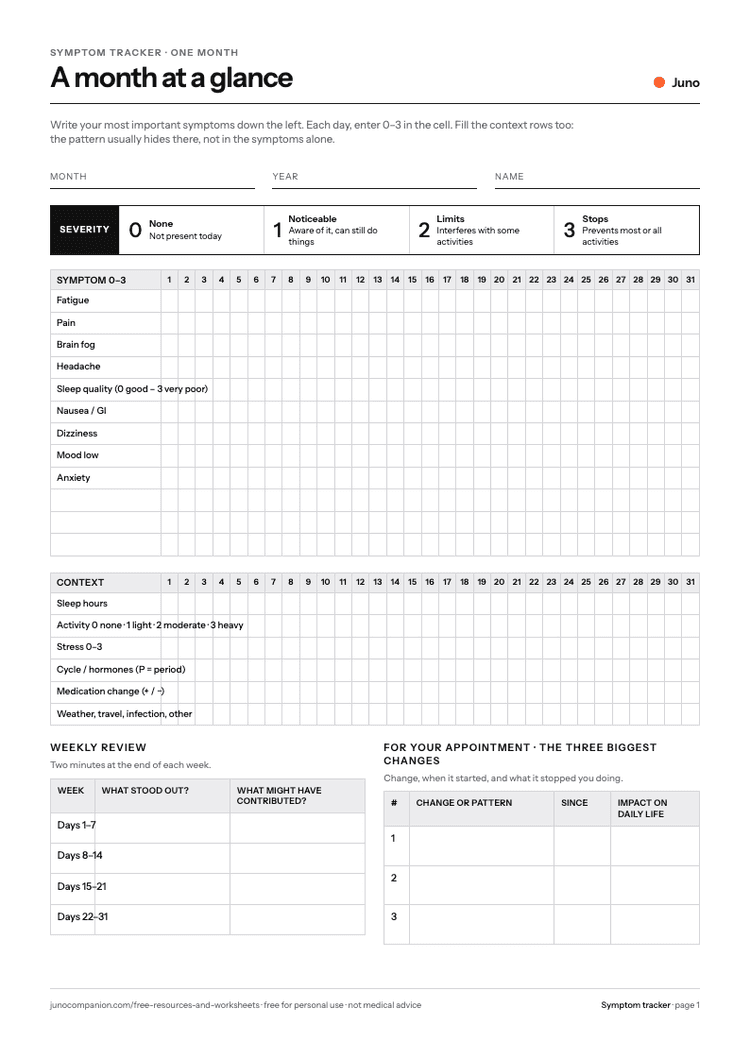
Prefer paper first? Print our free symptom tracker worksheet. Then download Juno and start your POTS diary with how you feel today.
What people say about tracking with Juno
★★★★★App Store
Everything in one place
“I have POTS, CRPS, EDS, SVT, and about billion other health issues. This app has not only helped me organize and manage my health information, meds, symptoms, and allergies.”
App Store review, US · November 2026
★★★★★App Store
Explain it out loud
“Works great at helping me keep track of my symptoms and concerns to bring up with for doctors appointments and my favorite part is that I can do an audio conversation with it and explain certain pains or symptoms that I’m feeling …”
App Store review, US · October 2026
★★★★★App Store
Something to show the doctor
“I had an appointment about 2 1/2 weeks after getting Juno and was able to give my doctor a visual of exactly how bad my pain was, the symptoms and so much more.”
App Store review, US · August 2026
Quoted as written from public App Store reviews.
When Is POTS an Emergency?
Some signs need help straight away.14
Get urgent care if a faint feels different from usual or recovery takes longer. See your doctor about new symptoms. Juno is not an emergency service.
Frequently asked questions
How is POTS treated?
Treatment starts with lifestyle changes: more fluids, smaller meals, support tights and gentle exercise. A doctor may also prescribe medicines such as fludrocortisone or beta blockers.
What is the best app for tracking POTS symptoms?
One you can use on a bad day that gives your doctor a readable summary. Juno logs symptoms by voice or text, adds wearable data and builds a free PDF report.
Can you exercise with POTS?
Yes, gently, and stop if symptoms start. The NHS suggests walking, pilates and swimming. The NINDS says activity that builds up slowly can help you stand for longer, though it doesn't suit everyone.
Is a symptom checker the same as a POTS symptom tracker?
No. A symptom checker suggests what you might have; a tracker records how you feel over weeks. For POTS, a tracker shows your doctor the posture, timing and triggers behind each symptom.
Juno features mentioned in this article
Sources
- PoTS UK: What is PoTS?
- NHS: Postural tachycardia syndrome (PoTS)
- NINDS: Postural tachycardia syndrome (POTS)
- Dysautonomia International: Postural orthostatic tachycardia syndrome
- PoTS UK: Diagnosis
- Cleveland Clinic: Postural orthostatic tachycardia syndrome (POTS)
- PoTS UK: GP guide
- PoTS UK: Diet and fluids
- GOV.UK: Definition of disability under the Equality Act 2010
- GOV.UK: Personal Independence Payment (PIP)
- Job Accommodation Network: Accommodation and compliance, POTS
- Umeda S, Harrison NA, Gray MA, Mathias CJ, Critchley HD. Structural brain abnormalities in postural tachycardia syndrome: a VBM-DARTEL study. Front Neurosci 2015;9:34
- PoTS UK: Sleep
- NHS: Fainting
Turn day-to-day notes into a clearer health story
Juno helps you track symptoms through conversation, notice patterns, and prepare a structured summary for appointments. Explore Juno’s POTS symptom tracker.


This article is for general information only and does not replace advice from your own clinician. Juno is a health assistant, not a medical provider.