Quick answer
MCAS symptoms often feel like an allergic reaction with no clear cause. Common signs are flushing, itching or hives, stomach cramps or diarrhoea, a racing heart or feeling faint, and wheezing or a stuffy nose. A flare usually hits two or more parts of the body at once. Throat swelling or struggling to breathe is an emergency.
MCAS flares often feel like an allergic reaction with no obvious cause: flushing, hives, stomach cramps and a racing heart arriving together.
MCAS stands for mast cell activation syndrome, where immune cells called mast cells release chemicals such as histamine too easily.2
What are the common symptoms of MCAS?
Doctors look at four areas: skin, gut, heart and blood pressure, and breathing. A flare usually involves at least two of them at the same time.1
MCAS symptom checklist
Tick what you’ve noticed. Next to each one, jot down when it happened and how long it lasted.
The four main areas
Skin
- Flushing: sudden redness or heat, often on the face and chest
- Itching
- Hives: raised, itchy welts
- Swelling of the lips, eyes, tongue or throat
Gut
- Stomach cramps
- Diarrhoea
- Nausea or vomiting
Heart and blood pressure
- Racing heart
- Low blood pressure
- Feeling lightheaded
- Fainting or nearly fainting
Breathing, nose and throat
- Wheezing or coughing
- Shortness of breath
- Stuffy nose
- Noisy or high-pitched breathing
Other common symptoms
- Brain fog
- Fatigue
- Headache
- Anxiety
- Itchy or watery eyes
- Reflux
- Constipation
- Muscle or joint pain
- Needing to pee urgently
A checklist can’t diagnose MCAS, but it helps you describe what happens.
People with MCAS often report the other common symptoms too.3
What helps your doctor most is the pattern: which symptoms come together, when, and for how long. Our MCAS symptom diary has a simple template.
When is it an emergency?
While you wait, lie down with your legs raised, or sit up slowly if breathing is hard, and don’t stand up even if you feel better. If you’re no better after 5 minutes, use a second pen if you have one.
What does an MCAS flare feel like?
Many people describe a sudden wave: a hot, flushed face and chest, itching or hives, stomach cramps or rushing to the toilet, and a pounding heart with lightheadedness.3
Flares vary from person to person and from one time to the next. Some are mild and pass on their own. Others are severe.
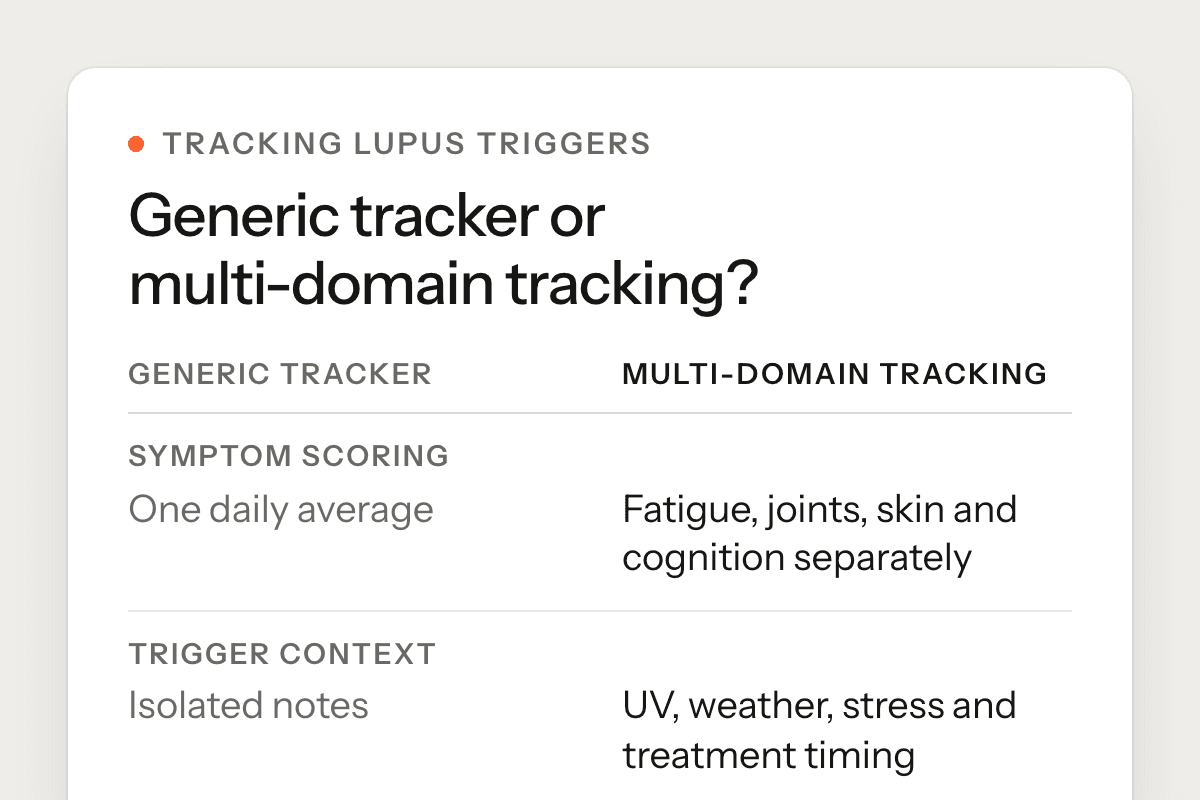
Some people find that several small triggers on the same day add up to a flare. Mast Cell Action calls this the bucket theory.4
What can trigger an MCAS flare?
Triggers are personal, and many flares have no clear cause. Common ones include:4
- Heat, cold or sudden temperature changes
- Exercise
- Stress
- Some foods and drinks
- Perfume, smoke and chemicals
- Infections
- Hormonal changes
- Poor sleep
- Some medicines, such as codeine, and for some people aspirin or ibuprofen
The last thing you ate isn’t always the cause. Check with your doctor before cutting out foods or stopping medicines.5
How is MCAS diagnosed?
MCAS is usually diagnosed by an allergist or immunologist. You need all three of these:2
- Flares that affect two or more parts of the body at once.
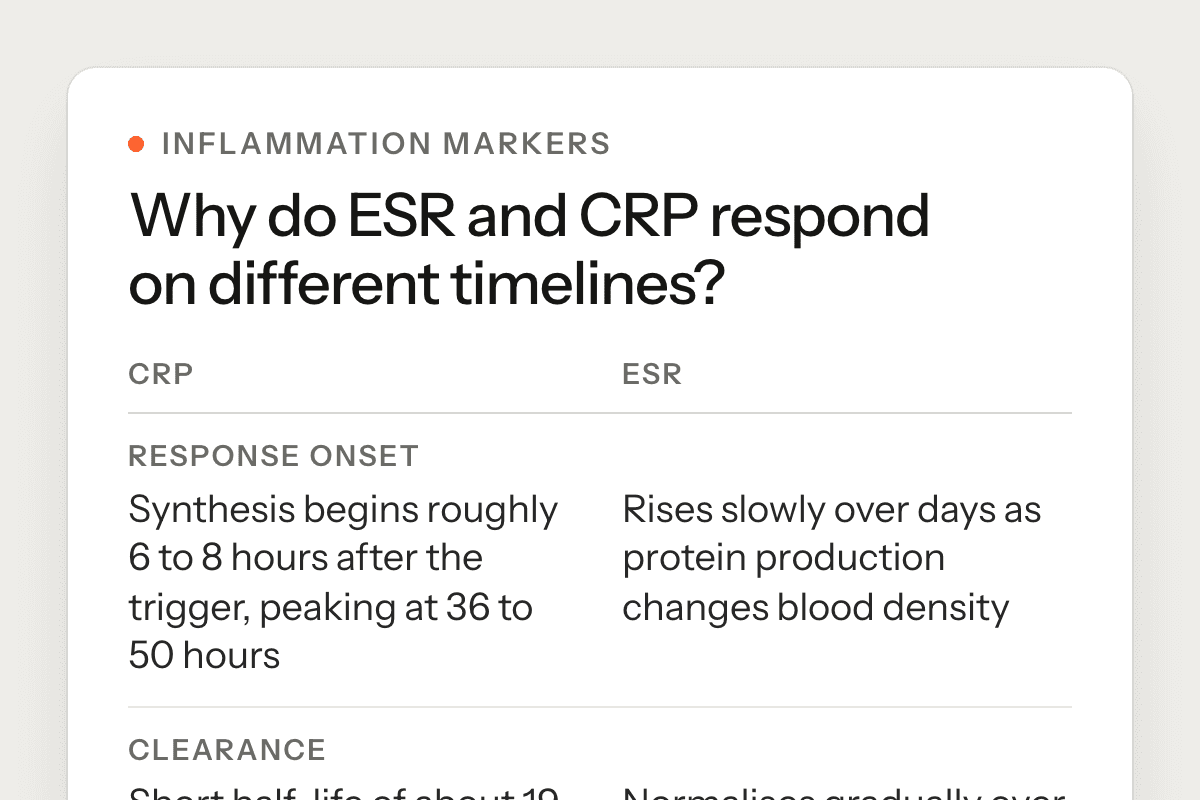
- A test showing that mast cell chemicals rose during a flare, usually tryptase in the blood.
- Symptoms that get better with medicines aimed at mast cells.
| Test | What it shows | When |
|---|---|---|
| Tryptase during a flare | Whether it rose above your normal level. A common rule is a rise of 20% plus 2 ng/mL. | Ideally 30 minutes to 2 hours after a flare starts |
| Baseline tryptase | Your normal level, for comparison | When you’re well, a day or two after a flare |
| Urine tests | Other mast cell chemicals (your specialist will choose which) | Soon after a flare, or over 24 hours |
| Other tests | Allergies and conditions that can look similar | As your specialist advises |
A high tryptase on its own doesn’t prove MCAS. Some people naturally have higher levels, including people with an inherited trait called hereditary alpha-tryptasemia.6
Because timing matters, ask your doctor for a plan before your next flare: where to go, and which tests to ask for.
Is MCAS linked to POTS and EDS?
Some MCAS symptoms, like a racing heart, dizziness and gut problems, overlap with POTS and hypermobile Ehlers-Danlos syndrome (EDS), and you may see the three called a “trifecta”. But the evidence for a true link is limited: a 2025 review found no studies using strict diagnostic criteria that confirmed one.7
If you have POTS or EDS and get flares like the ones above, it’s reasonable to ask your doctor about MCAS.
What should you ask your doctor?
See your doctor soon if flares are new, getting worse or happening more often. Bring your checklist, a few dated notes and a list of everything you take.
- Could this be MCAS, or something that looks like it?
- How do I get a tryptase test during my next flare?
- Should I see an allergist or immunologist?
- Do I need an emergency plan or an adrenaline pen?
- Are there medicines, or ingredients in medicines, I should avoid?
Our free appointment one-pager helps you fit it all on one page.
How can you keep track of MCAS symptoms?
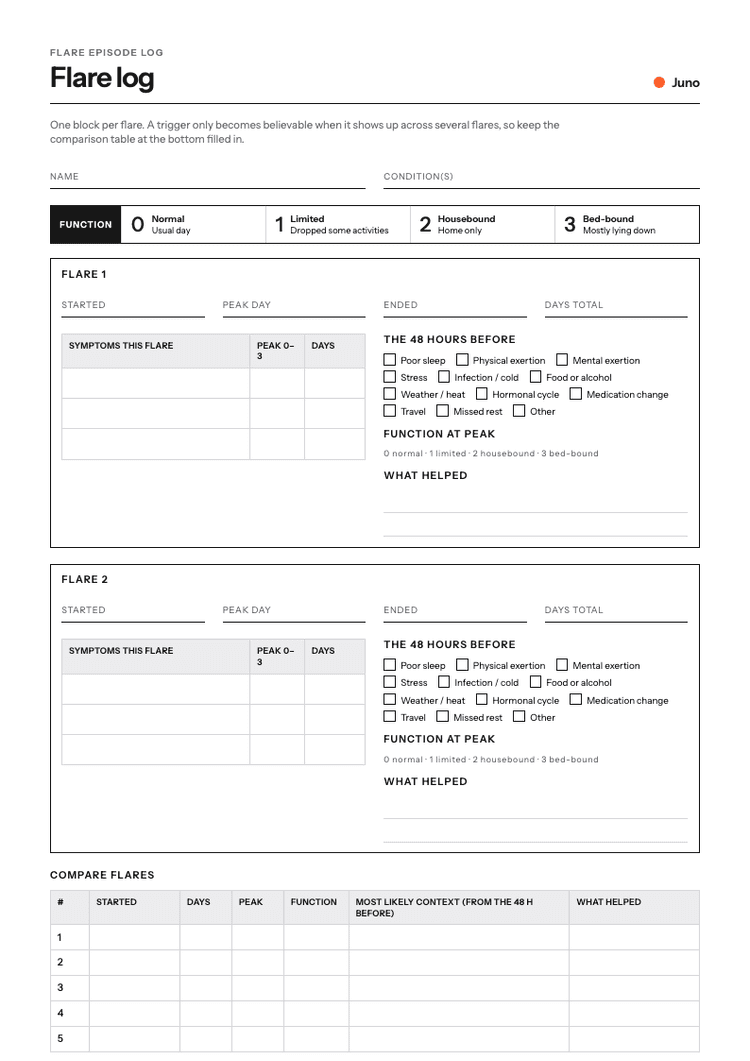
Short, regular notes beat a perfect log. For each flare, note when it started and stopped, what you felt, how bad it was and what happened just before. The MCAS symptom diary guide shows how.
If writing is hard during a flare, say it out loud instead. Juno’s MCAS symptom tracker lets you log symptoms by voice or text and keeps them on one timeline you can take to appointments. You can also try the free symptom tracker in your browser.
Frequently asked questions
What does an MCAS flare feel like?
Often like a sudden allergic reaction with no clear cause: flushing, itching or hives, stomach cramps or diarrhoea, a racing heart or feeling faint, and sometimes wheezing. Flares vary from person to person. Swelling of the throat or struggling to breathe is an emergency.
What supplements should I avoid if I have MCAS?
There’s no agreed list. Reactions are personal, and the fillers, colourings and preservatives in tablets can matter as much as the main ingredient. In the US, supplements aren’t approved by the FDA before they go on sale. Check with your doctor or pharmacist first and try one new product at a time.
What medications are commonly used to treat MCAS?
Common options are non-drowsy antihistamines such as cetirizine or fexofenadine, plus an H2 blocker such as famotidine. Cromolyn sodium, montelukast or omalizumab may be added, and adrenaline treats anaphylaxis. Plans are individual, so don’t start or change medicines without your doctor.
Can you reverse MCAS?
There’s no known cure, and there isn’t enough reliable data to know whether MCAS goes away over time. Treatment aims to control symptoms, often alongside avoiding your own triggers, and how well it works varies.
Is MCAS the same as mastocytosis?
No. In mastocytosis the body makes too many mast cells, usually because of a change in the KIT gene. In MCAS, mast cells release their chemicals too easily. Some people with mastocytosis also have MCAS flares.
Tools that go with this article
Sources
- Cleveland Clinic: Mast Cell Activation Syndrome (MCAS)
- American Academy of Allergy, Asthma & Immunology: Mast Cell Activation Syndrome (MCAS)
- Mast Cell Action: Symptoms
- Mast Cell Action: Identifying triggers
- Mast Cell Action: Management
- Valent P, et al. Diagnosis, classification and management of mast cell activation syndromes (MCAS) in the era of personalized medicine. International Journal of Molecular Sciences, 2020
- Farley M, et al. Prevalence of mast cell activation disorders and hereditary alpha tryptasemia among patients with POTS and Ehlers-Danlos syndrome: a systematic review. Annals of Allergy, Asthma & Immunology, 2025
- NHS: Anaphylaxis
- US Food and Drug Administration: Questions and answers on dietary supplements
Turn day-to-day notes into a clearer health story
Juno helps you track symptoms through conversation, notice patterns, and prepare a structured summary for appointments. Explore Juno’s MCAS symptom tracker. Download Juno on the App Store.
This article is for general information only and does not replace advice from your own clinician. Juno is a health assistant, not a medical provider.
Last updated: 2026-10-11