Common EDS symptoms in the joints, energy, gut and heart
Ehlers-Danlos syndrome symptoms vary a lot, even within one family. These are the ones doctors hear about most, mainly from people with hypermobile EDS (hEDS), the most common type.
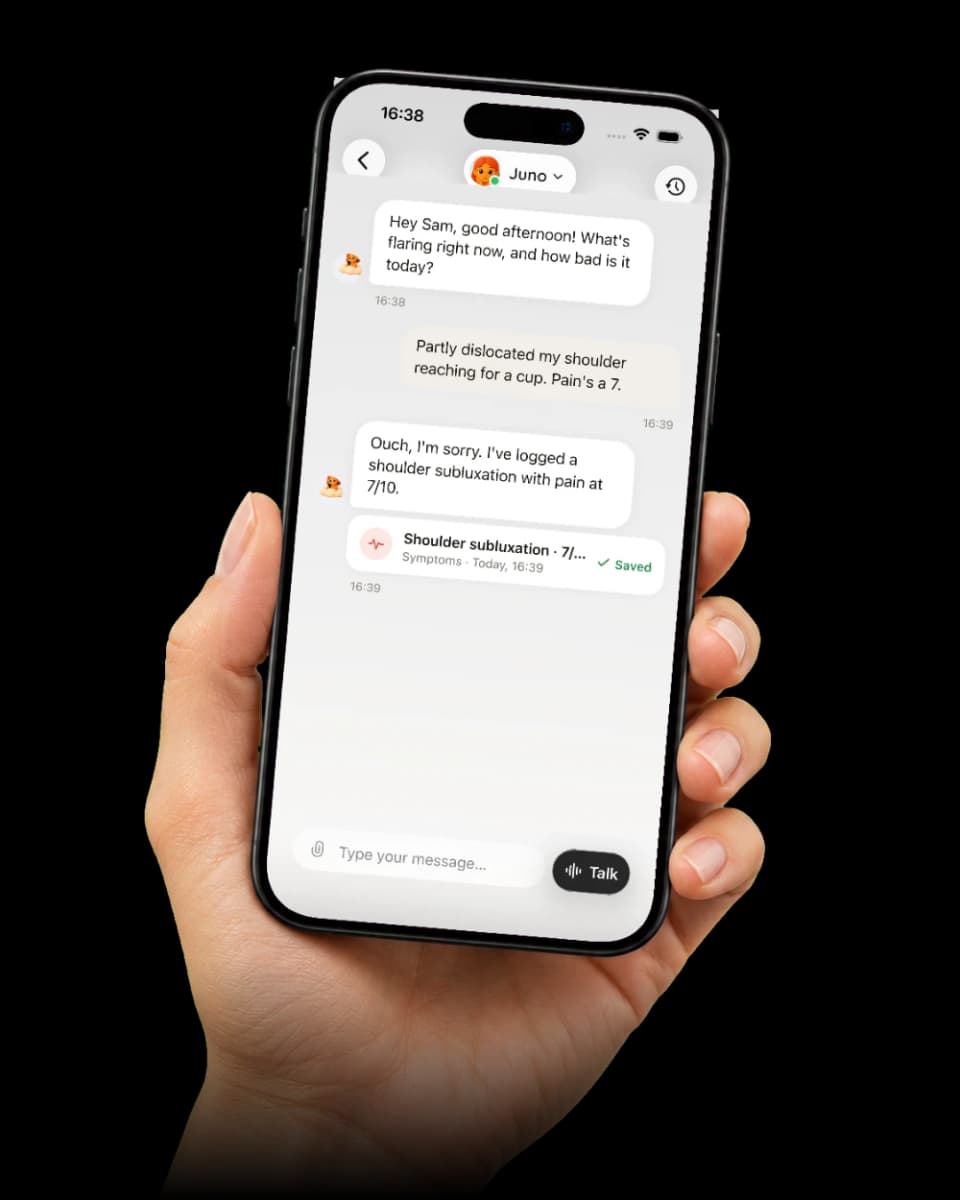
Joints. Joints bend further than usual and can feel loose or click. They may partly slip out of place (a subluxation) or fully dislocate, sometimes with little or no injury. Sprains and strains happen often. The jaw, neck and spine can be affected too.
Pain. Joint and muscle pain is common and can last for months or years. Many people with hEDS also get headaches or migraine. Pain often comes with poor sleep.
Tiredness. Long-lasting fatigue is one of the most common problems in hEDS. It can affect thinking and daily life as much as the joints do.
Gut. Reflux and heartburn, feeling full quickly, bloating, constipation and diarrhoea are common. The Ehlers-Danlos Society says up to 75% of people with hEDS have gut problems at some point.
Heart rate and dizziness. Many people feel dizzy, faint or have a racing heart when they stand up. This is often POTS or another problem with the automatic nervous system (dysautonomia). More on EDS and POTS below.
Bladder and pelvis. Bladder leaks, needing to pee urgently and prolapse are more common with hEDS.
Skin, face and eyes are covered in the next two sections. Vascular EDS is different: its main danger is arteries, the bowel or the womb tearing, so read the warning signs above.
EDS skin: soft, velvety, stretchy skin, bruising and atrophic scars
Skin changes are one of the clearest signs of EDS, but how strong they are depends on the type.
- Soft or velvety skin. Skin that feels unusually soft or smooth is one of the hEDS criteria. In classical EDS it can feel velvety or doughy.
- Stretchy skin. In hEDS the skin is only a little stretchier than usual. In classical EDS it stretches a lot and snaps back when let go.
- Easy bruising. Bruises can appear without a knock you remember, including in unusual places. Bruising is very easy in vascular EDS.
- Atrophic scars. Scars that are thin and sunken, or wider than the cut that made them. In classical EDS they can look like thin “cigarette paper”, often on the forehead, chin, knees and shins.
- Stretch marks. Stretch marks on the back, thighs, breasts or belly without weight change, often from teenage growth spurts.
- Thin, see-through skin. Skin where veins show clearly, especially on the chest, is a sign of vascular EDS.
For hEDS, doctors count atrophic scars only if they are on at least two parts of the body and came from a single cut or operation. Scars from acne, infections or repeated surgery do not count.
Can you see EDS? Signs in the face, eyes, skin, hands and feet
Usually not. Most people with hypermobile EDS look like anyone else. Some signs you can see do help doctors, especially with the rarer types.
| Where | What doctors look for | Most linked with |
|---|
| Face | A thin nose and lips, large or prominent eyes, a small chin and small earlobes | Vascular EDS |
|---|
| Eyes | A fold of skin over the inner corner of the eye (epicanthal fold), often seen in childhood | Classical EDS |
|---|
| Eyes | Dry eyes, strong short-sightedness and loose eyelids | Hypermobile EDS |
|---|
| Eyes | Blue-tinged whites of the eyes (blue sclerae) | Rare types, such as brittle cornea syndrome and kyphoscoliotic EDS |
|---|
| Skin | Soft, velvety skin that stretches and snaps back, with wide, thin scars on the forehead, chin, knees or shins | Classical EDS |
|---|
| Skin | Thin, see-through skin with visible veins, especially on the chest | Vascular EDS |
|---|
| Skin | Stretch marks without weight change, and easy bruising | Hypermobile EDS |
|---|
| Hands | Little fingers that bend back past 90 degrees and thumbs that touch the forearm | Hypermobile and classical EDS |
|---|
| Hands | Hands that look older than your age | Vascular EDS |
|---|
| Feet | Flat feet, and small bumps of fat on the heels when you stand | Hypermobile and classical EDS |
|---|
| Mouth | Crowded teeth and a high, narrow roof of the mouth | Hypermobile EDS |
|---|
Eye signs depend on the type. People with hEDS more often have dry eyes, strong short-sightedness and loose eyelids. Blue sclerae are listed in the 2017 criteria for some rare types, not for hEDS.
None of these signs means EDS on its own. Doctors look at the whole picture, including your history and your family.
What is the Beighton score? The hypermobility test
The Beighton score is the usual test for joint hypermobility. A doctor or physiotherapist checks five movements, four of them on both sides of the body, for up to 9 points.
| Joint | Scores a point if | Points |
|---|
| Little finger | It bends back more than 90 degrees | 1 per hand |
|---|
| Thumb | It bends back to touch the forearm | 1 per hand |
|---|
| Elbow | It bends backwards more than 10 degrees | 1 per arm |
|---|
| Knee | It bends backwards more than 10 degrees | 1 per leg |
|---|
| Forward bend | You can put your palms flat on the floor with your knees straight | 1 |
|---|
Joints get stiffer with age, so the score that counts as widespread hypermobility for hEDS depends on age:
| Age | Score that counts |
|---|
| Before puberty | 6 or more out of 9 |
|---|
| Puberty to age 50 | 5 or more out of 9 |
|---|
| Over 50 | 4 or more out of 9 |
|---|
If the score is 1 point below the cut-off, doctors can also ask five questions about how flexible you used to be (the five-point questionnaire). Two or more yes answers can count instead. Old injuries or surgery can lower a score.
A high score alone does not mean EDS. Only a clinician can diagnose hEDS, using the 2017 international criteria, which also look at skin and body signs, family history, pain or dislocations, and rule out other conditions. Shoulders, hips, jaw and ankles are not in the score but can be hypermobile too.
Is it hypermobility, HSD or EDS?
Flexible joints on their own are common and usually harmless. Around 1 in 30 people have hypermobile joints, and most do not have EDS.
Hypermobility spectrum disorder (HSD) is when flexible joints cause problems such as pain, sprains or dislocations, but you don’t meet the criteria for a type of EDS. HSD can affect your life as much as hEDS, and it is treated the same way.
Doctors usually start with the Beighton score, then look at the rest of the 2017 criteria.
Signs of EDS people notice growing up
EDS is present from birth, and symptoms often start in childhood. Signs that people with hEDS or HSD may notice as children or teenagers include:
- Being called “double-jointed”, or doing the splits and other bendy party tricks
- Bending a thumb back to touch the forearm
- Leg pain often put down to growing pains
- Hands that ache from handwriting at school
- Being clumsy, or having poor balance or co-ordination
- Frequent sprains, or a shoulder or kneecap that popped out more than once
- Fidgeting, finding it hard to sit still, or W-sitting on the floor
- Flat feet
- Bruising easily, sometimes without remembering a knock
- Stretch marks during growth spurts without weight change
- Crowded teeth and a high, narrow roof of the mouth
- Numbing injections at the dentist that didn’t work well
- Getting tired more easily than friends, even after rest
Many flexible children have none of these problems, and no list can diagnose EDS. If several sound familiar, the printable checklist helps you explain them to a doctor.
What are the symptoms of EDS in women?
The main symptoms are the same in women and men: flexible, unstable joints, pain, fatigue and skin that bruises easily. Women and girls tend to have more flexible joints than men and boys. Women with hypermobile EDS also often have:
- Heavy or painful periods
- Bladder leaks, or needing to pee urgently
- Prolapse, where the womb, bladder or bowel drops down
- Pain during sex
Studies suggest between 20% and 75% of people with hEDS have at least one pelvic floor problem. Pregnancy adds strain to loose joints and the pelvis, so tell your midwife or doctor about EDS early.
Vascular EDS makes pregnancy much riskier, because the womb and arteries can tear. If vascular EDS runs in your family, see a genetic counsellor before trying for a baby.
EDS symptoms in adults and children
People are born with EDS, but symptoms usually show in childhood. Children with hEDS may have leg pain often called growing pains, pain from repeated tasks such as handwriting, and poor co-ordination.
Most children are very flexible, so doctors are cautious. The 2017 hEDS criteria are for adults. Children with troublesome hypermobility are usually given a hypermobility diagnosis and checked again once they stop growing.
Joints tend to get a little less flexible with age. Long-lasting pain, fatigue, headaches and gut problems often become the main issue from the teenage years into the forties. Many adults are only diagnosed then.
When should you see a doctor about EDS symptoms?
See a GP or family doctor if you have several troublesome symptoms. They may refer you to a rheumatologist or a genetics service. You don’t usually need to worry about a few mild symptoms that aren’t causing problems.
Get medical help straight away for the vascular EDS warning signs above, or for sudden pain or bleeding you can’t explain, chest pain, trouble breathing, fainting when you stand, or sudden changes in your vision.



 Joint pain
 Shoulder
 Fatigue
 Dizziness
 Bruising
 Juno