A pelvic pain diary is a daily record of your pain level, where it hurts, what it feels like and your cycle day. Add bladder, bowel, food, sex, sleep and treatment notes if they seem relevant. Bring a short summary of your symptoms to your doctor’s appointment.
The short version
- Pelvic pain symptoms often overlap. Endometriosis, interstitial cystitis (IC/BPS), IBS and pelvic floor tension can all cause pain in the same area.
- Start with four things: your pain level, where it hurts, what it feels like and your cycle day. Add the rest if it seems relevant.
- A bladder diary is more detailed than a daily symptom log, so most people keep one for a few days only. Three days is common.
- Bring a short summary of your symptoms to your doctor’s appointment, and keep the full diary with you in case your clinician wants details.
- Call 999 (UK) or 911 (US) for sudden severe pelvic pain or heavy bleeding. Get medical advice the same day for pelvic pain with fever or during pregnancy.
On this page
You finally get the appointment. You sit down, the clinician asks “So, how has the pain been?” and your mind goes blank. Was the bad week before or after your period? Did the burning start after coffee, or after the long drive? Was it a 6 or an 8?
Pelvic pain rarely behaves the same way two days in a row, and a 15-minute appointment is not long enough to rebuild weeks of symptoms from memory. A pain diary (also called a symptom diary or pain journal) fixes that. A few minutes a day turns “it hurts sometimes” into a pattern your care team can actually work with.
Why keep a pain diary for pelvic pain?
Pelvic pain symptoms often overlap. Endometriosis, interstitial cystitis (IC/BPS), IBS and pelvic floor tension can all cause pain in the same area, and many people live with more than one.234 A diary helps you and your clinician:
- Spot patterns with your cycle, food, bladder, bowels, sex, sleep, stress or activity.34
- See what helps. A new medication, physiotherapy or diet change is easier to judge with a before-and-after record.
- Describe your experience accurately, instead of only remembering the worst day or the most recent one.
- Feel heard. Written records are hard to dismiss, and they show the real impact on your life.
What should you track in a pelvic pain diary?
You don’t need to track everything. Start with the first four items and add the rest if they seem relevant.
Pelvic pain diary checklist
Tick what you will track. Print it and keep it with your diary.
Start with these four
- Pain level: 0 to 10, morning and evening, or at its worst that day.
- Where it hurts: lower belly, one side, vulva, rectum, lower back, hips or thighs.
- What it feels like: aching, cramping, burning, stabbing, pressure or heaviness.
- Cycle day: if you menstruate, the first day of your period is day 1. Note the day of your symptoms.6
Add if relevant
- Bladder: the sudden urgent need to pass urine (urgency), how often you go, any incontinence brought on by coughing, laughing or exertion (stress incontinence), and pain as your bladder fills or after you empty it.716
- Bowels: stool type, constipation or diarrhoea, bloating, pain with bowel movements.15
- Food and drink: especially anything you suspect makes things worse.
- Sex: pain during or after, and how long it lasted.
- Sleep, stress and activity: a quick 1 to 5 rating is enough.
- Treatments: medications, heat, stretches, pelvic floor exercises, and whether they helped.
- Impact: what you missed or couldn’t do today.
This checklist cannot tell you what is causing your pain. It helps you give your clinician a clear picture.
How do you keep a bladder diary?
If bladder symptoms are part of your picture, your clinician may ask for a bladder diary (sometimes called a voiding diary). It’s more detailed than a daily symptom log, so most people keep one for a few days only. Three days is common, but follow what your clinician asks for.8910
For each day, record:
- Every drink: the time, what it was and roughly how much.810
- Every trip to the bathroom: the time and, if asked, how much you passed. A measuring jug or a collection “hat” from a pharmacy makes this easy.810
- Urgency: how strong the need to go was, from 0 (none) to 4 (couldn’t wait).11
- Leaks: when they happened and what you were doing.10
- Pain: before, during or after urinating.
Endometriosis, IBS or IC? Tailor your tracking
| Condition | What to add to your diary |
|---|---|
| Endometriosis | Line pain up with your cycle. Note pain with bowel movements, urination or sex, and fatigue.512 |
| IBS | Pair food with symptoms a few hours later, and add a bowel diary entry (stool type and timing). Stress and sleep matter too.131415 |
| IC/BPS | Track bladder pain alongside food and drinks, and note any flare after sex, tight clothing or long periods of sitting.161718 |
An endometriosis symptom tracker that marks cycle days makes patterns easier to see. For the food side of IBS, see our IBS food diary guide.
Paper, spreadsheet or symptom tracker app?
The best diary is the one you’ll actually keep. A notebook by the bed works for many people. A spreadsheet makes it easy to sort and chart. A symptom tracker app can send reminders, show trends and produce a summary to share at appointments.
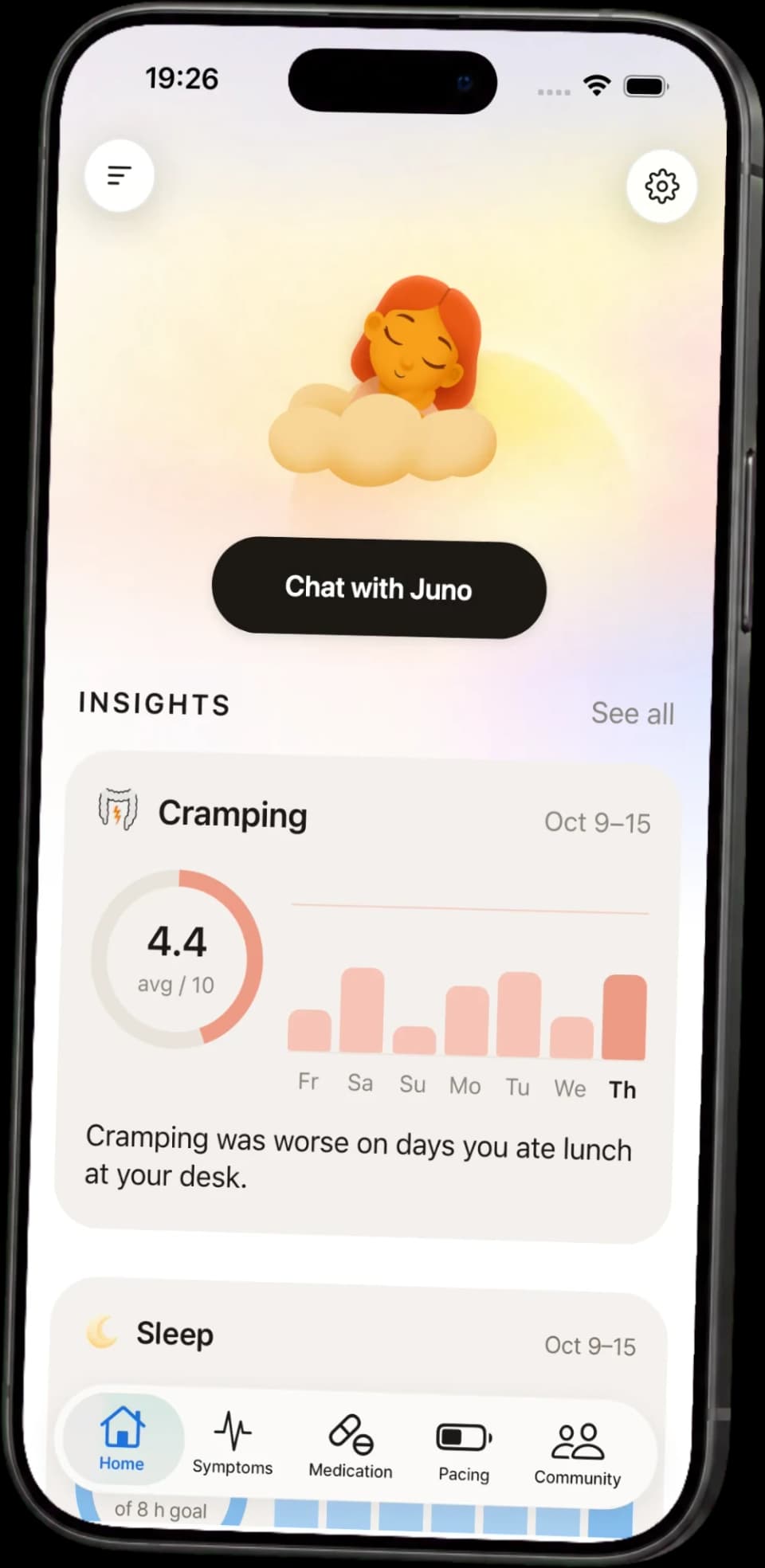
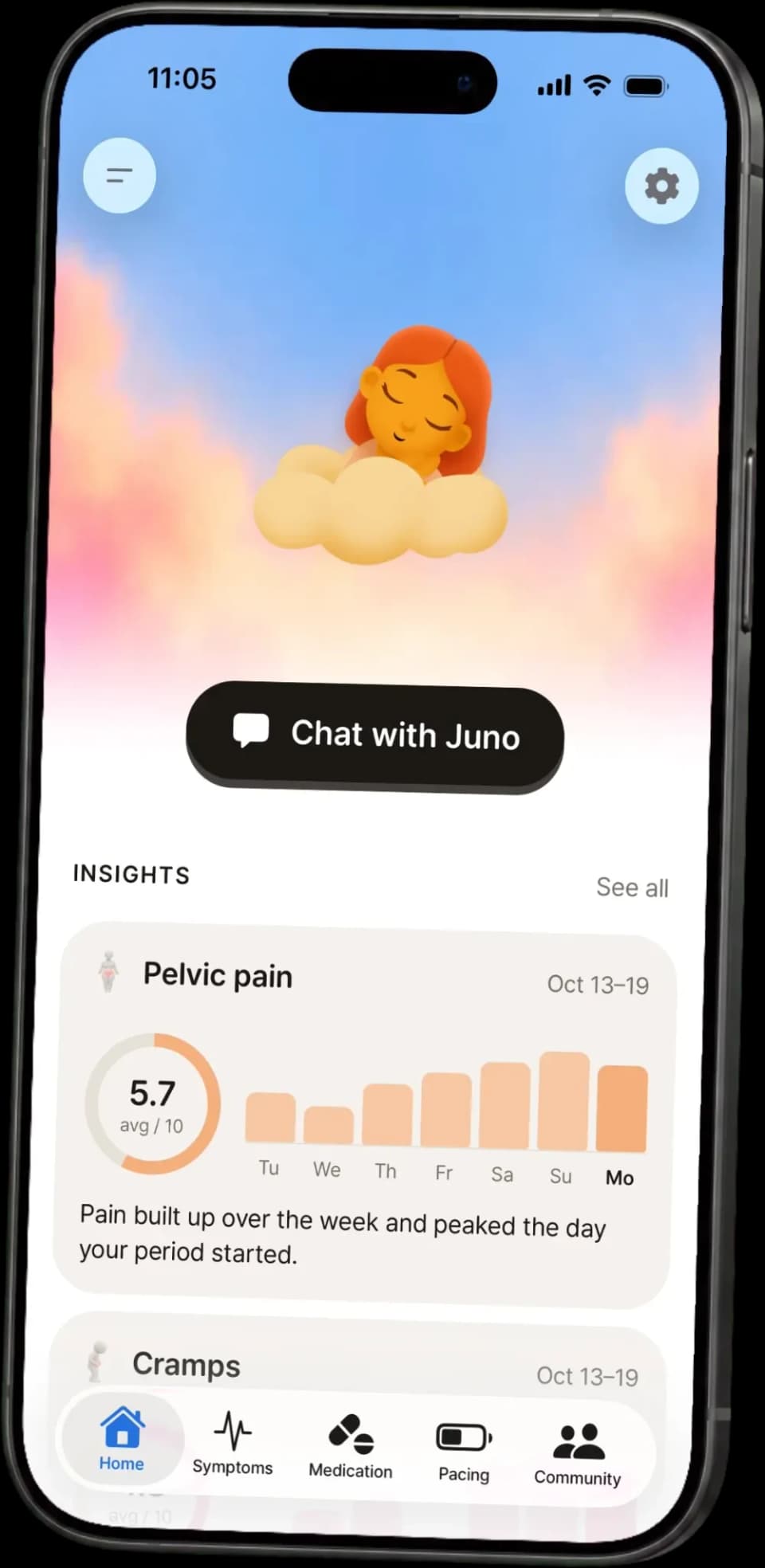
In Juno, a symptom tracker app for people living with chronic conditions, you can log pain, bladder and bowel symptoms, food and medications by typing or talking, then turn your history into a summary to bring to your doctor.
How do you bring your diary to your appointment?
Please bring a short summary of your symptoms to your doctor’s appointment:
- Your top three symptoms, and how often each happens.
- Your average and worst pain over the last month.
- Patterns you’ve noticed (“worse days 1 to 3 of my period”, “flares after coffee”).
- What you’ve tried, and what changed.
- Your questions, most important first.
Keep the full diary with you in case your clinician wants details. Our free appointment one-pager gives you one page to write the summary on.
Start tonight
Tonight, write down three things: your pain level, where it hurt, and one thing that might have affected it. That’s your diary started. After two weeks, you’ll have something more useful and easier than memory alone.
When does pelvic pain need urgent care?
Get medical help straight away for sudden severe pelvic pain, pain with fever, heavy bleeding, or pain during pregnancy.11920 A diary supports care from a qualified clinician; it doesn’t replace it.
Get medical advice the same day (NHS 111 in the UK, or your doctor or an urgent care clinic elsewhere) if you have pelvic pain and a very high temperature (or you feel hot, cold or shivery), you are or may be pregnant, there is blood in your pee or poo, you find it difficult to pee or poo, you have pain when you pee or need to pee more than usual, you have vomiting and diarrhoea or feel sick, or you have unusual discharge, fluid or bleeding from your vagina. If you are 20 weeks pregnant or more, contact your midwife or maternity unit.1
Frequently asked questions
What should I write in a pelvic pain diary?
Start with your pain level from 0 to 10, where it hurts, what it feels like and your cycle day. Add bladder, bowel, food and drink, sex, sleep, stress, activity, treatments and the impact on your day if they seem relevant.
How long should I keep a bladder diary?
Is a paper diary or a symptom tracker app better?
The best diary is the one you’ll actually keep. A notebook by the bed works for many people. A spreadsheet makes it easy to sort and chart. A symptom tracker app can send reminders, show trends and produce a summary to share at appointments.
What should I bring to my doctor’s appointment?
Bring a short summary: your top three symptoms and how often each happens, your average and worst pain over the last month, patterns you’ve noticed, what you’ve tried and what changed, and your questions, most important first. Keep the full diary with you in case your clinician wants details.
When is pelvic pain an emergency?
Call 911 (US) or 999 (UK), or go to an emergency department, if you have pelvic pain that is severe, getting worse, or hurts when you move or touch the area, or pelvic pain with feeling faint or dizzy or passing out, shoulder-tip pain, difficulty breathing, heavy bleeding from your vagina or sudden confusion. Get advice the same day for pelvic pain with a very high temperature, blood in your pee or poo, difficulty peeing or pooing, pain when peeing or needing to pee more than usual, vomiting and diarrhoea or feeling sick, or unusual discharge or bleeding from your vagina, or if you are or may be pregnant.11920
Tools that go with this article
Sources
- NHS: Pelvic pain
- Royal College of Obstetricians and Gynaecologists: Long-term pelvic pain (patient information)
- Royal College of Obstetricians and Gynaecologists: The Initial Management of Chronic Pelvic Pain (Green-top Guideline No. 41)
- American College of Obstetricians and Gynecologists: Chronic pelvic pain
- NICE guideline NG73: Endometriosis: diagnosis and management
- NHS: Periods and fertility in the menstrual cycle
- NHS: Urinary incontinence, symptoms
- NHS: Urinary incontinence, diagnosis
- NICE guideline NG123: Urinary incontinence and pelvic organ prolapse in women: management
- National Institute of Diabetes and Digestive and Kidney Diseases: Diagnosis of bladder control problems
- Notte SM and others, BMC Urology (2012): the Patient Perception of Intensity of Urgency Scale
- NHS: Endometriosis
- NHS: Diet, lifestyle and medicines for IBS
- NHS: Symptoms of IBS
- NHS England: Bristol stool chart
- NHS: Bladder pain syndrome (interstitial cystitis)
- National Institute of Diabetes and Digestive and Kidney Diseases: Symptoms and causes of interstitial cystitis
- Mayo Clinic: Interstitial cystitis, symptoms and causes
- American College of Obstetricians and Gynecologists: Ectopic pregnancy
- NHS: Ectopic pregnancy
Turn day-to-day notes into a clearer health story
Juno helps you track symptoms through conversation, notice patterns, and prepare a structured summary for appointments. Explore Juno’s symptom tracker. Download Juno on the App Store.
This article is for general information only and does not replace advice from your own clinician. Juno is a health assistant, not a medical provider.
Last updated 22 November 2026