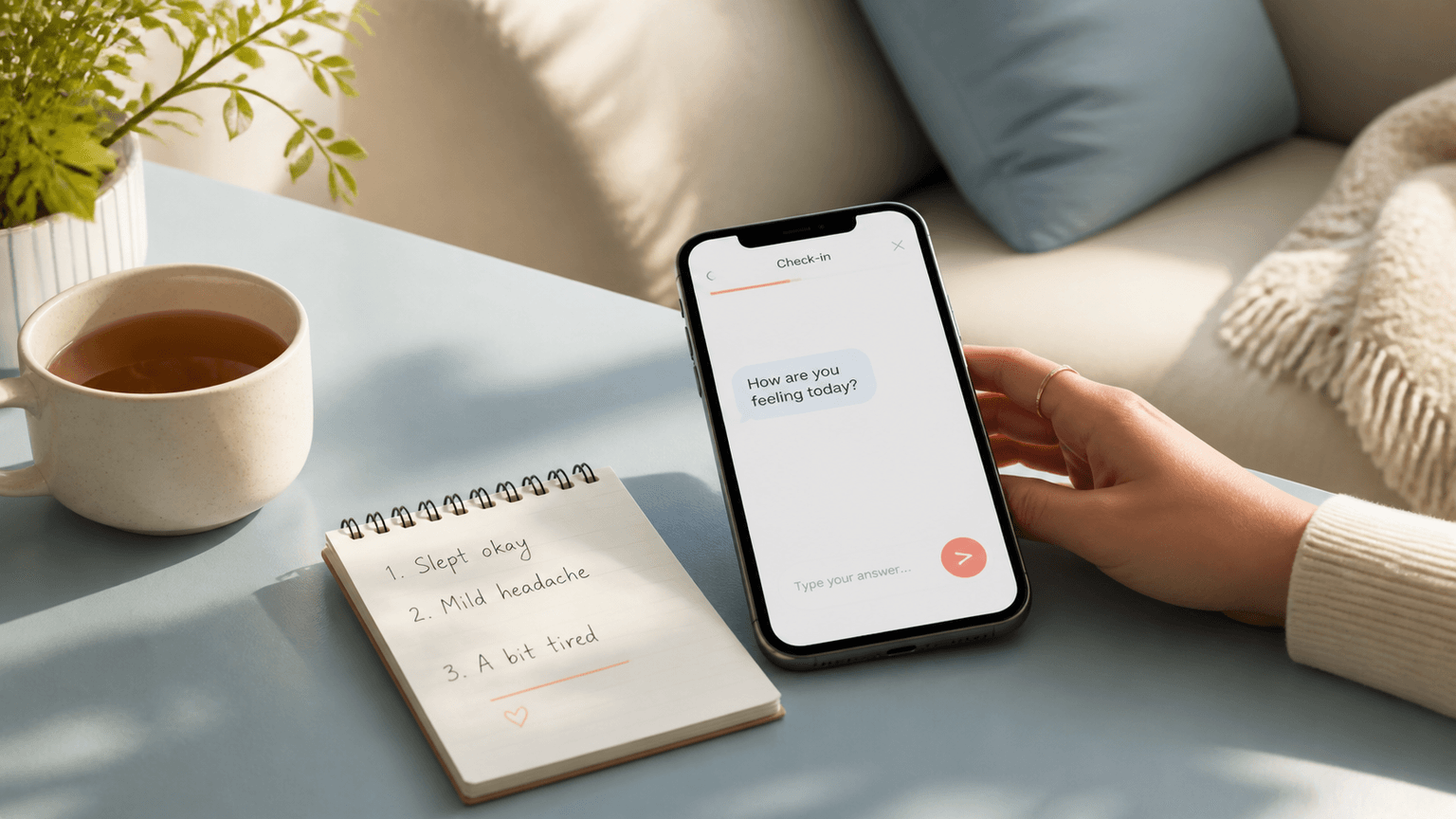
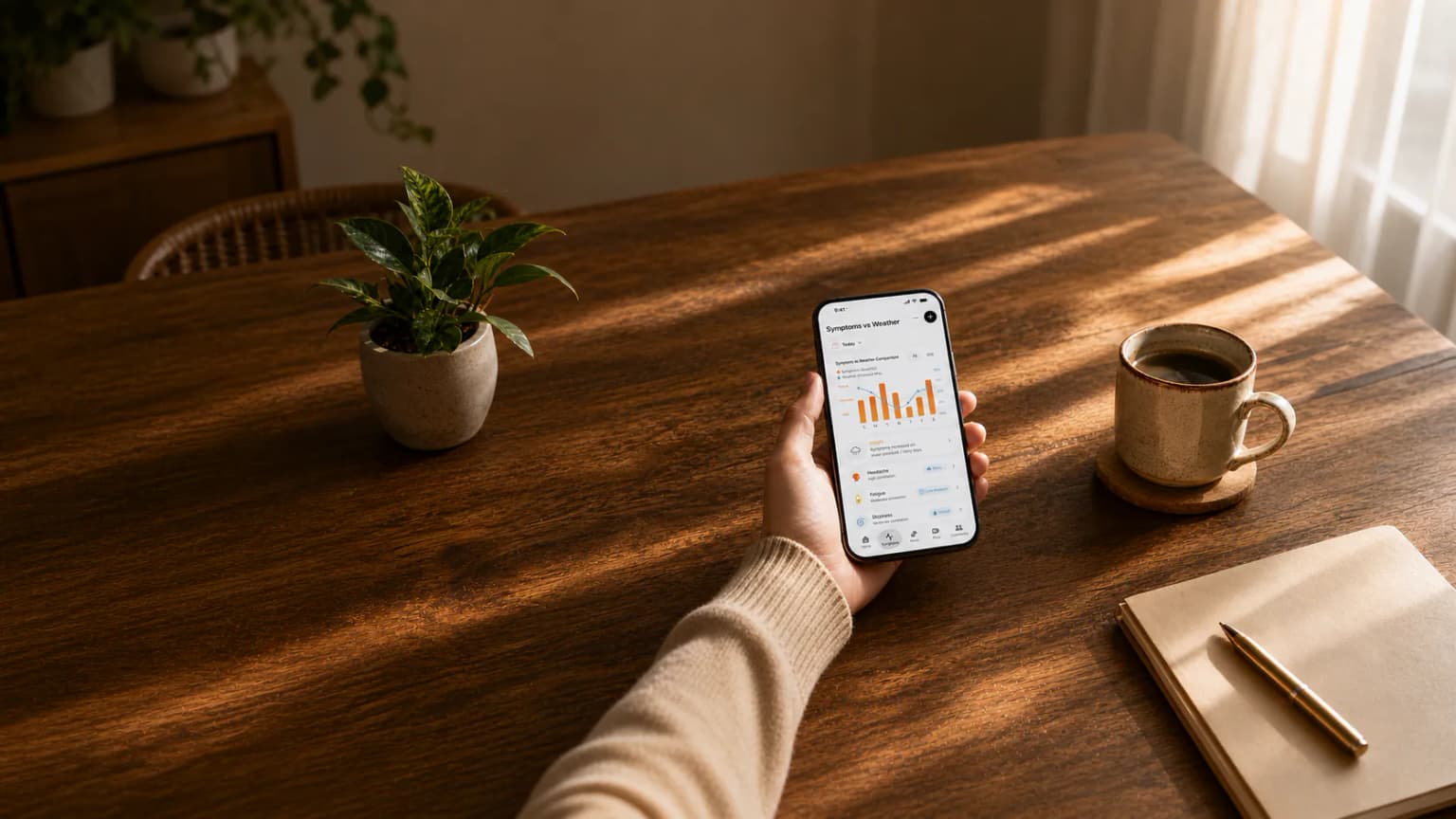

The dates, the difficult mornings, the things you had to cancel: your history can tell a clearer story.
Quick answer
Juno keeps your symptom notes next to the rest of your day, so you can see what tends to change together. When the same thing keeps happening, especially with a delay, it is worth raising with your doctor. A pattern does not prove a trigger, predict your next flare, or mean you caused it. Missing days stay unknown.
What can a symptom history help you notice?
By the time the appointment comes round, the weeks have blurred. You know you have been unwell, but not whether the headaches started before the bad sleep or which week the fatigue changed. Then you are sitting in a clinic trying to rebuild the story from memory, through brain fog, in a fifteen-minute slot.
A handful of dated notes changes that conversation. Juno looks at what you tell her in chat alongside sleep, activity, wearable data and things like weather, temperature and pollen, and helps you notice what tends to move together. [1] Think of these as clues to take to your care team, not verdicts.
The useful question is usually small. “Has this happened more than once?” “Did things change after that week?” You do not need a full explanation for your notes to be worth bringing along.
Which details make a pattern more useful?
Start with the symptoms that matter most to you. Add context when you have the energy for it, especially what a symptom stopped, delayed or changed in your day.
| Worth noting | Something like | Why it helps |
|---|---|---|
| Symptom and timing | Headache started Tuesday afternoon | Puts the change on a timeline |
| What it did to your day | Had to stop reading after ten minutes | Shows what the symptom meant for you |
| Activity and rest | Appointment yesterday, rested after | Gives context for anything delayed |
| Other changes | Slept badly; started a new prescription last week | Keeps other explanations in view |
These are examples, not a form to fill in. “Much worse today” still records something real. Our guide to tracking without burnout is about keeping the effort small enough to keep going.
A wearable reading is one more piece of context, not the whole story. A watch cannot tell how hard a conversation was or how much getting dressed took out of you. Your own account belongs next to the numbers.
Why do delayed symptoms matter?
With ME/CFS, post-exertional malaise can hit hours or days after physical or mental effort, and recovery can drag on. [2] If you only look at what happened on the day, you miss the thing that actually cost you.
Say you note an appointment on Monday and worse fatigue on Wednesday. That timing is worth writing down. It does not prove the appointment did it. Sleep, a bug, a medication change or the illness doing its own thing could all be part of the picture.
Look back over the days before, when that fits your experience, without forcing every crash into a fixed window. Our delayed PEM guide goes into this properly. And please do not push yourself on purpose to test a theory.
How much confidence should you place in a pattern?
Before you treat a pattern as real, look at the notes underneath it. Did the same thing happen more than once? Were the dates right? Was something else changing at the same time?
- Something that happened repeatedly is worth more of a conversation than a single coincidence.
- Missing days stay unknown, and logging is usually hardest during a flare, which is exactly when the gaps appear.
- A link in the past does not tell you what will happen next.
- No obvious pattern does not mean there is no problem.
An app can be wrong about a connection, or miss the one that matters. A history helps you organise uncertainty; it does not remove it. It should never become a reason to blame yourself, cut out foods you do not need to, or change prescribed treatment without advice.
A good habit is to ask: “Which entries led to that suggestion, and what else could explain it?” If you cannot see the notes behind a suggestion, hold it loosely.
How can you bring a possible pattern to your doctor?
Pick the one or two things that matter most. Bring the dates, what changed, and what you are unsure about. “My fatigue was worse on three days after appointments. Could we look at what else might explain that?” is a strong question, and it does not claim you have found the cause.
- Choose the symptom or change you want help with.
- Bring a few dated examples and what they did to your day.
- Mention anything else that changed, like sleep or a new medicine.
- Ask what would be useful to record next, if anything.
Juno can turn your history into a summary or doctor letter to share, or a PDF to print. You choose what goes in, and there is no direct doctor portal yet. [1] Our example report shows the format using made-up details.
What if keeping a history feels like too much?
Start with one symptom, or one line a day, and leave gaps when you need to. If a screen is the problem, a printable symptom tracker may suit you better.
If you live with ME/CFS or another condition that swings from week to week, recording less is often the sensible way to keep recording at all. Juno is one way to keep the story in one place. The record is there to help you, not to become another thing you owe.
Frequently asked questions
Does a pattern prove what triggered my symptoms?
No. Two things changing together is a useful clue, but timing alone does not prove cause. Other things may explain it, and gaps in your notes can mislead. Take it to your clinician as a question rather than a conclusion.
Can Juno predict my next flare?
Looking back over your history can show possible links, but describing what happened before is not the same as reliably predicting what comes next. Do not treat a reassuring pattern or an energy score as proof that an activity will be safe.
How long do I need to track?
There is no magic number of days that makes a pattern reliable. How often you log, the gaps, how your illness is changing and the question you are asking all matter. Even a short history can help explain a recent change.
What if no pattern appears?
Your symptoms still count. Your history may not have enough in it to show a link, or there may be no simple link to find. Dated notes and a few examples of what a symptom did to your day still make an appointment easier.
Can my doctor access Juno directly?
Not yet. You choose what to share as a summary, doctor letter or printed PDF. Read it first and check dates, symptoms, treatment details and anything that could have been misunderstood.
Tools that go with this article
Sources
Turn day-to-day notes into a clearer health story
Juno helps you track symptoms through conversation, notice patterns, and prepare a structured summary for appointments. See how Juno works. Download Juno on the App Store.
This article is for general information only and does not replace advice from your own clinician. Juno is a health assistant, not a medical provider.
Last updated: 2026-09-28