
In short
- hEDS needs the full 2017 criteria, while HSD covers symptomatic hypermobility that doesn't meet them
- Both are diagnosed from your history and an examination, so a dated record of your symptoms matters more than the label
- Gut symptoms, dizziness and fatigue often come with both
- Juno logs each joint slip, pain score and dizzy spell in your own words, and keeps POTS and MCAS symptoms in the same timeline
- Juno turns those entries into a free patient-generated symptom report for your GP, physio or specialist
On this page
What Is hEDS and How Is It Different From Hypermobility Spectrum Disorder?
Hypermobile Ehlers-Danlos syndrome (hEDS) and hypermobility spectrum disorder (HSD) both describe joints that move further than usual and cause problems: pain, instability, subluxations and injuries. The difference is a checklist. hEDS is diagnosed when someone meets all three of the 2017 criteria. HSD is the diagnosis when hypermobility causes symptoms but the hEDS criteria are not all met.1
That can feel like a technicality when you are the one with the sore shoulder. It is. There is no lab test that tells the two apart, and some experts think they are one condition on a spectrum. Care is the same for both.1 Juno helps with either label: you say what happened, and she keeps the record your doctor will ask for.
The 2017 hEDS Criteria in Plain Words
To be diagnosed with hEDS, a person needs all three of these:2
- Generalised joint hypermobility, usually checked with the Beighton score
- At least two of three features: signs of a connective tissue disorder (at least 5 of 12, such as soft or stretchy skin, unexplained stretch marks, hernias, a high or narrow palate, or mitral valve prolapse); a parent, sibling or child who meets the hEDS criteria; or musculoskeletal problems, such as daily pain in two or more limbs for 3 months or recurrent dislocations without injury
- Other causes ruled out, including other types of EDS, autoimmune conditions such as lupus, and other connective tissue disorders
hEDS vs HSD at a Glance
| hEDS | HSD | |
|---|---|---|
| Criteria | All three 2017 criteria | Symptomatic hypermobility, hEDS criteria not met |
| How common | At least 1 in 3,100–5,000 people | Not known, believed to be common |
| Test | No lab test | No lab or imaging test |
| Inheritance | 50% chance of passing it on | Often runs in families |
| Treatment | Managing symptoms | Managing symptoms, the same way |
Sources: the Ehlers-Danlos Society on hEDS and HSD, and Arthritis UK on hypermobility.23
hEDS is the most common type of EDS, about 90% of cases.2 HSD comes in four types: generalised, peripheral (hands and feet), localised (one area) and historical (hypermobile in the past). A diagnosis can also change, from HSD to hEDS, if new features appear later.1
If you were told years ago that you have joint hypermobility syndrome (JHS) or benign joint hypermobility syndrome, that name is outdated. Most people with it now count as hEDS or HSD.1
How Do You Get Diagnosed With hEDS or HSD?
Both are diagnosed from your medical history and a physical examination, with other conditions ruled out first.1 There is no genetic test for hEDS yet.2 Rarer types of EDS can be confirmed with a genetic blood test.4
The Beighton Score
The Beighton score gives one point for each of these movements, out of 9:5
- Each little finger bends back beyond 90 degrees (2 points)
- Each thumb can be pushed back to touch the forearm (2 points)
- Each elbow bends back more than 10 degrees past straight (2 points)
- Each knee bends back more than 10 degrees past straight (2 points)
- Palms flat on the floor with straight knees (1 point)
A score of 5 or more counts as positive in adults, 6 in children before puberty and 4 after age 50. The score doesn't test your jaw, shoulders, hips or ankles, so a doctor looks at those joints too.1
On the NHS and in the US
In the UK, start with your GP. They will usually check your joints with the Beighton score, and may order a blood test or X-ray to rule out arthritis.6 The NHS says a GP may be able to diagnose EDS from your symptoms; suspected rarer types go to a specialist for genetic testing.4 A GP may refer you to a physiotherapist, occupational therapist or podiatrist.6
In the US, a primary care doctor or physical therapist can assess your joints. The Ehlers-Danlos Society keeps a directory of clinicians who know hEDS and HSD.2 Because care often involves several specialists, you may need to repeat your story more than once. A one-page summary saves you from rebuilding it every time.
What Are 7 Signs You Have Hypermobility?
The NHS lists 7 signs that point to joint hypermobility causing problems:6
- You often get tired, even after rest
- You keep getting pain and stiffness in your joints or muscles
- You keep getting sprains and strains
- Your joints keep dislocating, or "pop out"
- You have poor balance or co-ordination
- You have thin, stretchy skin
- You have bladder or bowel problems
Being flexible alone isn't a problem. Up to about 20% of people are hypermobile, and dancers and gymnasts often gain from it.1 It becomes a disorder when it causes pain, instability or other symptoms. In Juno, you can note which of these happen to you and when, which is exactly what a GP will ask about.
Is Hypermobility a Form of Autism?
No. Hypermobility is about connective tissue; autism is a neurodevelopmental condition. But the two often occur together. A Swedish registry study found people with EDS were 7.4 times more likely to be diagnosed with autism, and 5.6 times more likely with ADHD. Results were similar for hypermobility syndrome.7
A UK study of 109 neurodivergent adults found 51% were hypermobile, against about 20% in the general population. Hypermobility was also linked to more dizziness on standing and more pain.8 The Ehlers-Danlos Society lists autism and ADHD among conditions seen with hEDS.2
Neither study shows that one causes the other. If you are autistic and describing body sensations is hard, logging them as they happen can help. You don't have to find the right words in a short appointment.
What Are the Symptoms of Hypermobility Stiffness?
Hypermobility stiffness usually means aching, tight joints and muscles, even though the joints bend further than usual. Arthritis UK describes pain and stiffness in joints and muscles, particularly towards the end of the day and after physical activity. Clicking joints, back and neck pain often come with it.3
Hypermobility can also change with age: some people who were very flexible when younger find they are less flexible in their 30s or 40s, and stretching becomes uncomfortable.3 Hypermobile joints wear faster, so osteoarthritis can start earlier in hEDS.2
The NHS suggests warm baths, hot water bottles or heat-rub cream for pain and stiffness. Don't overextend your joints just because you can, and take regular breaks from repetitive tasks.6 When you log stiffness, note the time of day and what you did before. A pattern of "worse after cleaning, eased by evening" is useful to a physio.
What Are the Common Digestive Problems Associated With Hypermobility?
Gut problems are common with both hEDS and HSD. The Ehlers-Danlos Society lists:2
- Reflux (GERD): stomach acid flowing back up, causing heartburn
- Gastroparesis: a stomach that empties slowly, with nausea and feeling full early
- IBS: belly pain and changes in bowel habits
- Constipation or diarrhoea
- Nausea, vomiting and belly pain
- Trouble swallowing
Arthritis UK explains this can happen when the muscles that move food through the gut are weak. It names IBS and reflux as common, and gastroparesis as less common.3
Gut symptoms are easy to forget by the time you see a doctor. Log meals and symptoms side by side, with times. Our IBS food diary guide shows how, and Juno's gastroparesis tracker covers slow emptying.
What Are Some Weird Symptoms of Hypermobility?
Some symptoms don't sound connected to joints at all. People with hEDS may have:2
- Dizziness or a racing heart when standing, often from dysautonomia, the nervous system problem behind POTS
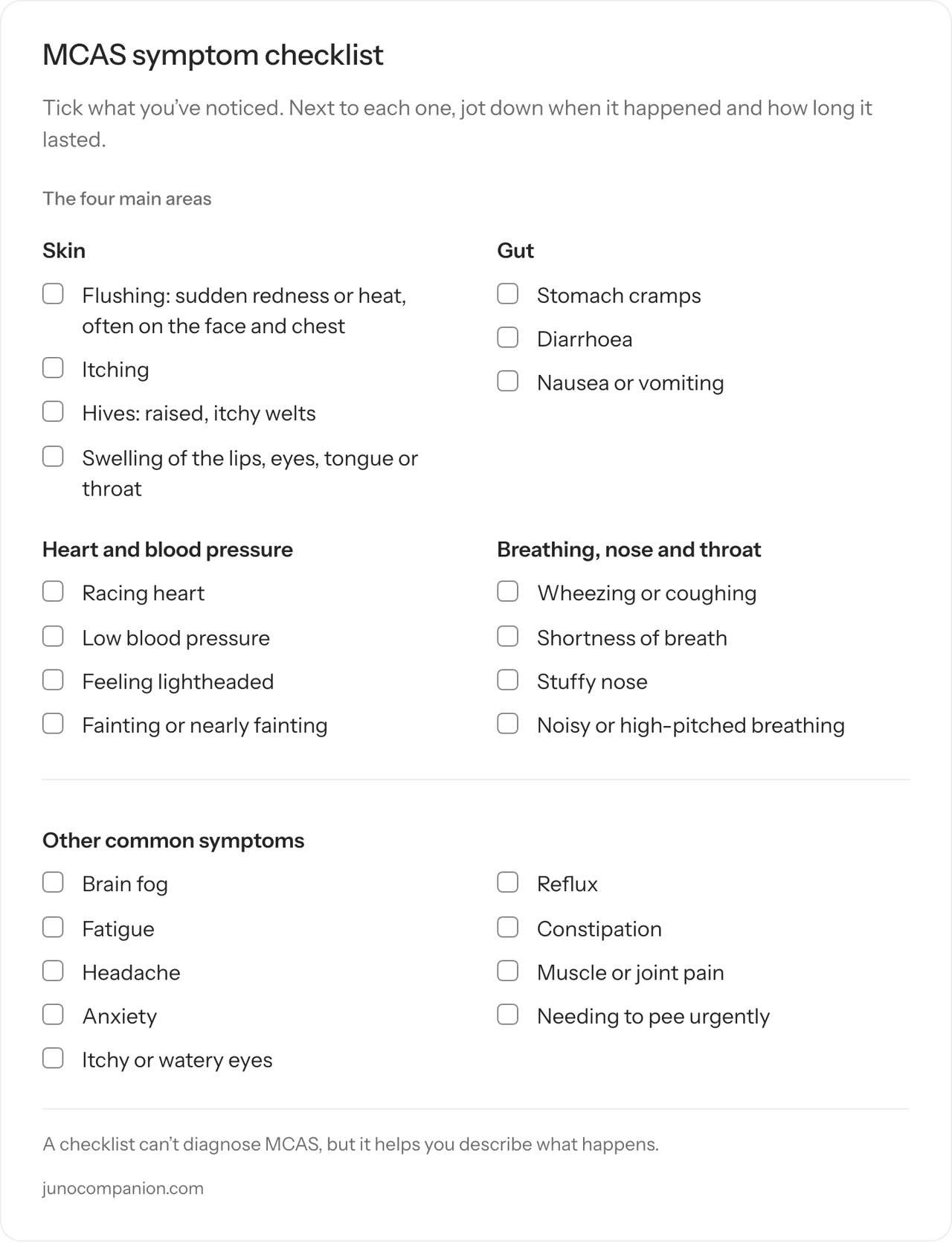
- Mast cell problems, such as mast cell activation syndrome (MCAS)
- Small bumps on both heels (piezogenic papules)
- Jaw clicking or pain (temporomandibular joint dysfunction)
- A high or narrow palate and crowded teeth
- Easy bruising and soft, velvety skin
- Fatigue and sleep that doesn't refresh you
Arthritis UK adds one more: some hypermobile people don't respond well to local anaesthetics, so tell your dentist.3 If your heart races when you stand, read our guides to POTS symptoms and MCAS symptoms.
Many people live with hEDS or HSD, POTS and MCAS at once. Juno tracks symptoms, not labels, so all three sit in one timeline.
How to Track hEDS or HSD Symptoms With Juno
Juno is a free AI health assistant for people living with chronic illness, built on research from Oxford and UCL. For hEDS and HSD, Juno logs each joint event in your own words and lines it up with everything else.
Tell Juno what happened, by voice or text: "My kneecap slipped on the stairs, pain's about a 6, and I've felt dizzy since." She saves the joint, the severity and what you were doing, with the date. Speaking helps on days when typing hurts.
Log subluxations and dislocations joint by joint, so your record shows which ones slip and how often. Add fatigue, gut symptoms and dizziness as they happen. Juno also reads sleep, heart-rate and activity data from more than 20 wearables, including Apple Health, Fitbit, Oura and Garmin. She shows what changes together as a clue to review with your care team, not proof of a cause.
After 7 days with data, Juno can turn your entries into a patient-generated symptom report you share as a PDF (example report). You choose what to share. Juno doesn't diagnose hEDS or HSD; she helps you bring a clear history to the person who can. Symptom tracking, pacing and doctor reports are free (Juno FAQ), and Juno's EDS tracker shows how it works.
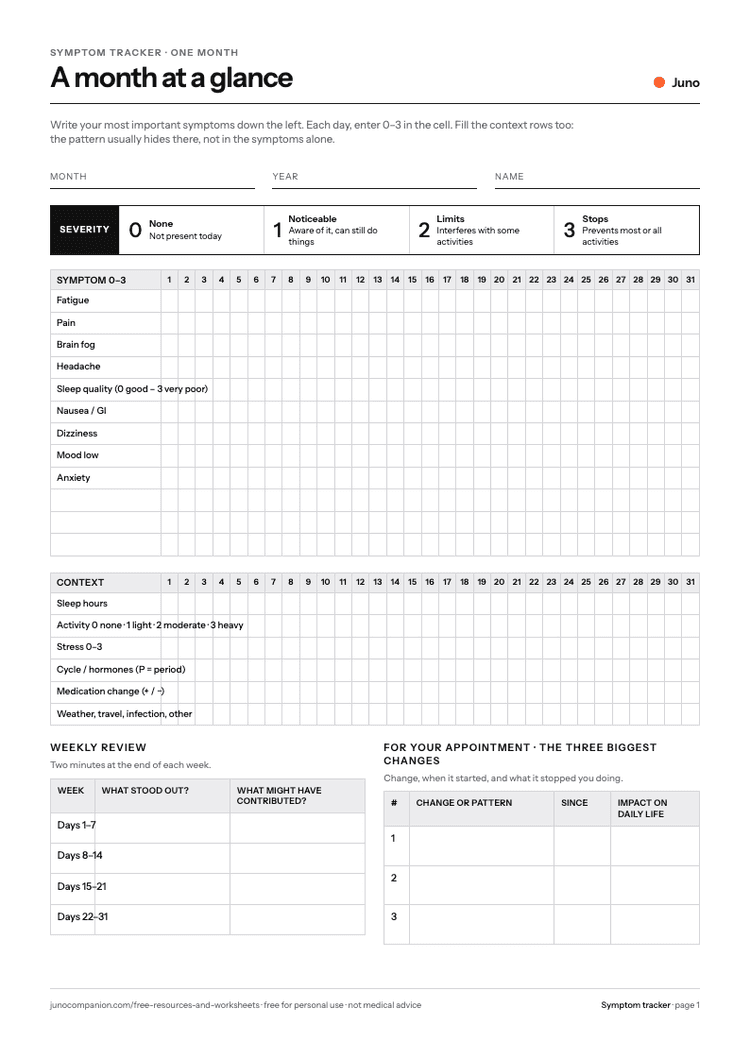
Prefer paper first? Print our free symptom tracker worksheet. Then download Juno and log your next joint slip as it happens.
What people say about tracking with Juno
★★★★★App Store
Everything in one place
“I have POTS, CRPS, EDS, SVT, and about billion other health issues. This app has not only helped me organize and manage my health information, meds, symptoms, and allergies.”
App Store review, US · November 2026
★★★★★App Store
Words for the doctor
“Having all the data compiled into a single page PDF to bring with to my doctors appointments is extremely beneficial for tracking my chronic illness. Highly recommend especially if you have difficultly putting your physical symptoms into words for your doctors.”
App Store review, US · October 2026
★★★★★App Store
Concrete data for appointments
“This has genuinely changed my life, being able to take concrete data to doctors appointments, being able to track patterns in symptoms, being able to track spoon costs, this whole app is exactly what a person with chronic illness needs.”
App Store review, US · May 2026
Quoted as written from public App Store reviews.
When to Get Urgent Help
Never try to push a dislocated joint back into place yourself. Go to A&E or the emergency room.9 Call 999 (UK), 911 (US) or your local emergency number if someone has fainted and cannot be woken within 1 minute, has chest pain or a pounding heartbeat, or has seriously hurt themselves.10
See your GP if symptoms are getting worse or affecting your life.4 Juno is not an emergency service.
Frequently asked questions
Is HSD less serious than hEDS?
No. Both can cause the same problems and are managed in the same way. Someone with HSD can have more symptoms than someone with hEDS.
Is there a test for hEDS or HSD?
No. There is no blood, genetic or imaging test for either. A doctor diagnoses them from your history and an examination, after ruling out other conditions.
How are hEDS and HSD treated?
There is no cure, so care manages symptoms. Physiotherapy to strengthen muscles around the joints comes first, with occupational therapy, pain management and podiatry when needed.
Is there a good app for tracking hEDS or hypermobility symptoms?
Look for one you can use on a bad day that tracks each joint separately. Juno logs subluxations, pain and dizziness by voice or text and builds a free PDF report for your doctor.
Can HSD turn into hEDS?
Yes, it can. If new features appear later, such as stretch marks, hernias or mitral valve prolapse, someone diagnosed with HSD may then meet the hEDS criteria.
Juno features mentioned in this article
Sources
- The Ehlers-Danlos Society: What is HSD?
- The Ehlers-Danlos Society: Hypermobile Ehlers-Danlos syndrome (hEDS)
- Arthritis UK: Joint hypermobility
- NHS: Ehlers-Danlos syndromes (EDS)
- The Ehlers-Danlos Society: Assessing joint hypermobility
- NHS: Joint hypermobility syndrome
- Cederlöf M, Larsson H, Lichtenstein P, et al. Nationwide population-based cohort study of psychiatric disorders in individuals with Ehlers-Danlos syndrome or hypermobility syndrome and their siblings. BMC Psychiatry 2016;16:207
- Csecs JLL, Iodice V, Rae CL, et al. Joint hypermobility links neurodivergence to dysautonomia and pain. Front Psychiatry 2022;12:786916
- Cleveland Clinic: Ehlers-Danlos syndrome (EDS)
- NHS: Fainting
Turn day-to-day notes into a clearer health story
Juno helps you track symptoms through conversation, notice patterns, and prepare a structured summary for appointments. Explore Juno’s EDS symptom tracker.


This article is for general information only and does not replace advice from your own clinician. Juno is a health assistant, not a medical provider.