
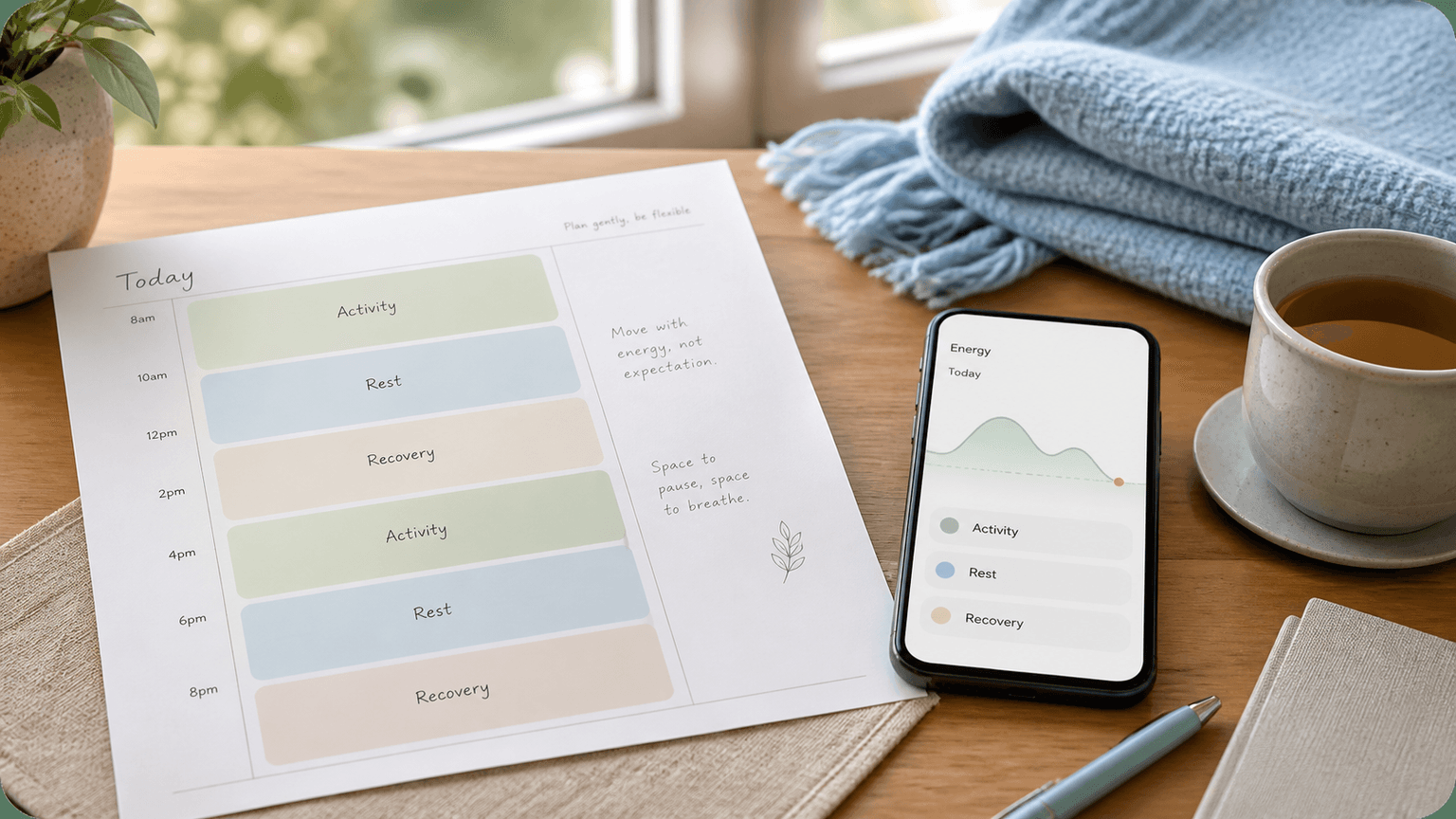

A shower, a call and an appointment can be a full day. Make a plan that leaves room for you.
Quick answer
Juno keeps your plans, spoon estimates and symptom notes in one place, so planning takes less remembering. Start with how you feel today, add what the day asks of you, and change the plan when you need to. Estimates are a planning aid. Your symptoms and your own care plan always come first.
What does pacing mean on an ordinary day?
A shower, a work call and picking up a prescription can use up a day before anything on the to-do list gets a look-in. When energy is limited, planning is mostly deciding what can wait. That is hard enough without having to remember every activity and symptom on your own.
Pacing means working within your current limits and adjusting when they change. NICE describes energy management for ME/CFS as a flexible approach led by the person living with it, not a fixed programme of doing a bit more each week. [1]
Juno keeps the plan and the history together: activities in your calendar, an estimate of what each will cost in spoons, and the conversations about how you actually feel. [3] [4] That lets you think a day through without holding every piece in your head. Sometimes the useful outcome is simply seeing that the shopping can wait.
What counts as effort when you plan your day?
Start with whatever would change today’s plan. “I slept badly, my legs feel heavy, and I’ve got an appointment this afternoon” is useful on its own, with no number and no complete log.
| Kind of demand | An everyday example | Worth noting |
|---|---|---|
| Physical | Showering, or getting to an appointment | Standing, travel and recovery time |
| Mental | Forms, reading, a work call | Concentration and decisions |
| Emotional | A difficult conversation | How draining it felt |
| Sensory | A busy shop or a bright waiting room | Noise, light and how long you were there |
These overlap, and you do not need to score each one. A short note about what felt heavy is often enough to plan differently next time.
Our energy pacing guide covers breaking tasks down and building rest into the day.
How can you build a flexible day in Juno?
Start with the day you actually have. “I slept badly, my legs feel heavy and I’ve got an appointment at three” is a far better starting point than yesterday’s plan.
- Check in with how your energy and symptoms are right now, including anything that changes what feels doable.
- Add the activities you are weighing up, with how long they take. Getting ready, travel and recovery often cost as much as the thing itself.
- Look at the estimated spoon costs and decide what is essential, what can be shortened, and what can move.
- Leave space for rest and for surprises, then change the plan if your symptoms change.
An appointment, for example, is really washing, travelling, waiting, concentrating and getting home again. Seeing those parts side by side makes it easier to ask for a lift, write your notes the night before, or keep the rest of the afternoon clear. These are options to bend to your own life, not a schedule to follow.
How should you use a spoon estimate?
Juno uses spoons to stand for a limited energy budget and to estimate what a planned activity will take. Use the estimate to compare choices: a shorter call, a different time, a task split in two. It is a rough planning aid, not a clinical measurement of what your body can safely do.
The same task can feel completely different after a broken night, during a flare, or when someone is helping. Your experience outranks the estimate. Having spoons left does not mean you have to spend them, and going over does not mean you failed.
Rest belongs in the plan, but it is not a guaranteed refill. No app can tell you exactly how much you will get back from a break.
What can you change when the day gets harder?
Say you planned a shower, a phone call and a shop. By lunchtime the shower has taken more out of you than you expected. You might move the call, ask someone else to do the shop, or keep only the one thing that cannot wait. That is pacing in practice, not a rule about how much you should do.
- Keep the task that matters most today, if it is manageable.
- Shorten or split another task when that helps.
- Ask for practical help where it exists.
- Leave room for rest without needing to earn it.
Some days there is very little room to move. Work, caring for someone else and money all shape what you can change. A hard day is not evidence that you paced badly.
Why look beyond today’s energy?
For a lot of us, symptoms get worse hours or days after physical or mental effort. That is post-exertional malaise, or PEM. Recovery can take days or weeks, and the timing varies. [2] A same-day energy score simply cannot see that far.
Short activity notes help you and your clinician look at what came before a flare. They cannot prove a cause or predict the next crash, and you do not need to test your limits on purpose to get useful information.
If you live with ME/CFS, talk to a clinician who understands PEM about an individual energy plan. Our guide to delayed PEM explains why the gap between effort and symptoms matters so much.
Where can you start?
Try one short note about how you feel and one about an activity that mattered. Keep only as much detail as is useful to you. If an app feels like one more job, our free energy and fatigue tracker is the paper version.
Pick one activity you would like to make lighter. Explore Juno’s pacing tools, or sketch an easier version of the day on the paper tracker. Once you have a few notes, our guide to symptom patterns with Juno shows how that history turns into useful questions.
Frequently asked questions
How does Juno help with energy pacing?
Juno puts your planned activities, their estimated spoon costs and your symptom conversations side by side, so you can see what a day is really asking of you and compare options. The estimates stay rough. They do not set a safe limit or replace an individual care plan.
Do I have to use spoons?
No. Ordinary words work, like “a bit better than yesterday” or “too tired to cook”. A number is only useful if it helps you communicate or notice a change. How you say you feel matters more than any scoring system.
Does resting mean I can add more activities?
Rest helps, but it does not top you up by a predictable amount. Avoid treating a break as a fixed refill. Go by how you feel, watch for delayed effects, and talk to your clinician about how to manage activity.
Can pacing prevent every flare?
No. Pacing makes activity more manageable, but it is not a cure and it cannot guarantee anything. Illness fluctuates for all sorts of reasons, many of them outside your control. A flare is not proof you did something wrong.
Do I need a wearable to start?
No. Short notes about symptoms, activity, rest and how the day felt are useful on their own. Wearable data can add context where you have it, but it cannot see every demand or replace your own account.
Tools that go with this article
Sources
Turn day-to-day notes into a clearer health story
Juno helps you track symptoms through conversation, notice patterns, and prepare a structured summary for appointments. See how Juno works. Download Juno on the App Store.
This article is for general information only and does not replace advice from your own clinician. Juno is a health assistant, not a medical provider.
Last updated: 2026-09-28