Updated 12 August 2026

Learn how to use energy pacing to manage chronic illness, budget your energy levels daily, avoid post-exertional malaise, and prevent symptom flares.
Quick answer
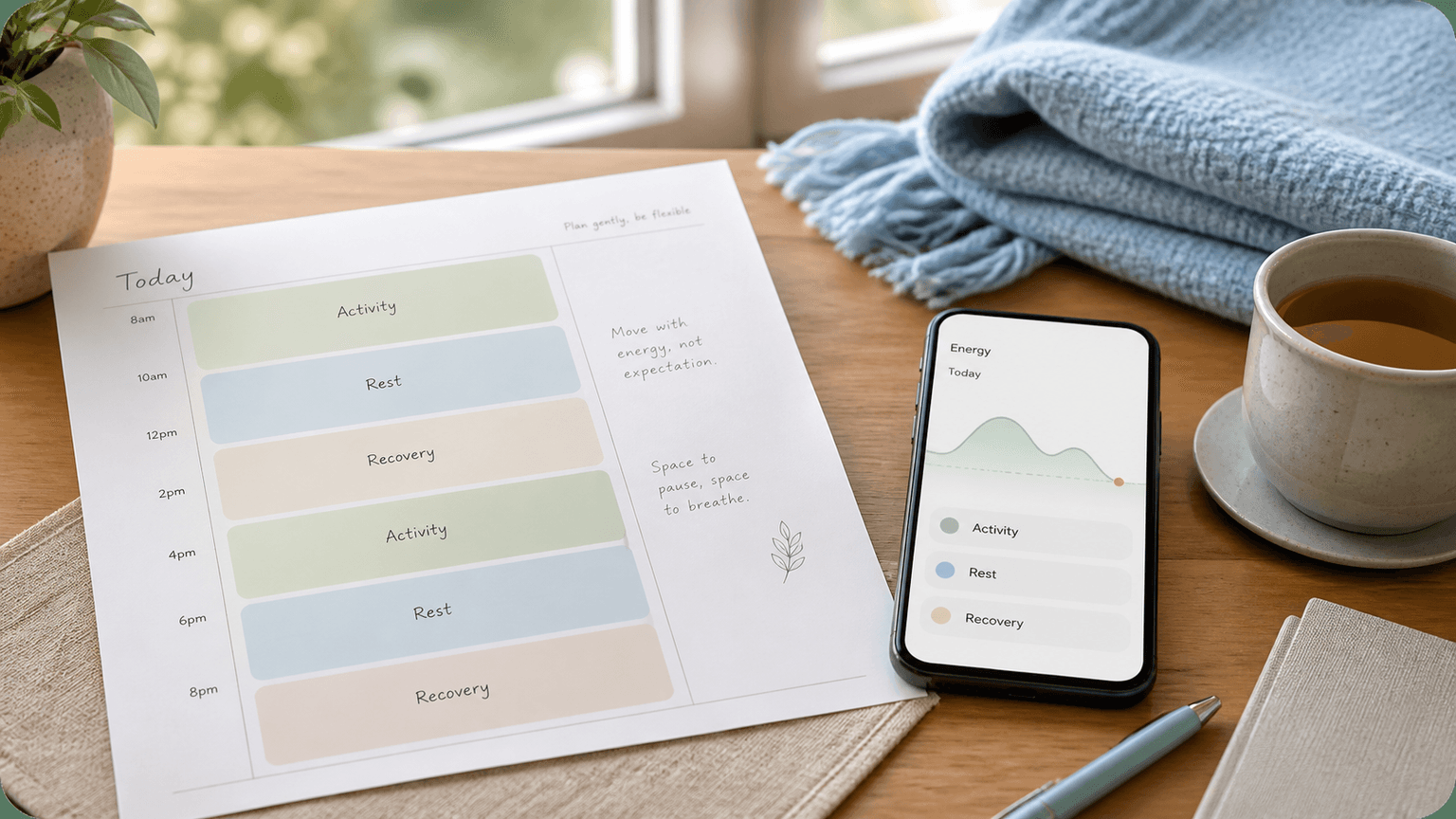
Energy pacing means balancing activity and rest within your current limits, then adjusting as symptoms change. Track physical, cognitive, emotional, and social demands alongside recovery and post-exertional symptoms. The aim is not a fixed increase in activity; it is a flexible, individual pattern that reduces the risk of worsening symptoms.
No one really talks about how much admin comes with living with a chronic illness. It is not just dealing with the symptoms themselves. It is remembering medication every day, ordering refills before you run out, keeping track of appointments, noticing changes in your body, and constantly trying to work out why you feel better one day and much worse the next.
You can end up mentally tracking dozens of things without even realising it. How did I sleep? What did I eat? Did I walk too much yesterday? Have I been stressed? Is this a medication side effect? Is it the weather? Did I stand for too long? Am I getting sick, or is this just another flare? When your energy is already limited, carrying all of that information around in your head can become exhausting in itself.
This is where pacing can help. Pacing is not about following a perfect routine or finding some magic formula that stops you from ever having a bad day. It is simply a way of becoming more aware of the energy you have available and making decisions that are less likely to leave you completely depleted afterwards. The aim is not to squeeze as much as possible out of every day. It is to make life a little more sustainable.
What does your energy envelope actually look like?
One of the hardest things about chronic illness is that your energy does not behave like a normal battery. You do not necessarily wake up with the same amount every morning, and rest does not always bring you straight back to full capacity. Some days a shower might feel manageable. On another day, that same shower can take up a huge amount of the energy you have available.
Finding your baseline means starting to understand what you can usually manage without causing a significant worsening of your symptoms afterwards. It is less about finding an exact number and more about noticing what your body tends to tolerate.
That can be difficult because energy is not only physical. Writing emails, concentrating on work, being in a noisy room, having a difficult conversation, making lots of decisions or spending time around other people can all take energy too. Sometimes the thing that tips you over the edge is not one enormous activity. It is ten small things stacked on top of one another.
This is also why pacing can feel frustrating at first. On a good day, it is natural to want to catch up on everything you could not do while you were unwell. You clean the kitchen, answer messages, go to the supermarket and finally deal with the laundry. Then the next day arrives and your body makes it very clear that yesterday cost more energy than it seemed to at the time.
Pacing is partly about learning to stop before you reach that point.
How do you make everyday life smaller without losing it?
An everyday task is rarely just one task when you are chronically ill. Making dinner means deciding what to eat, finding the ingredients, standing in the kitchen, preparing everything, cooking, eating and eventually cleaning up afterwards. Laundry means gathering clothes, carrying them, loading the machine, unloading it, hanging things up and putting everything away.
When all of those steps are grouped together in your head as one job, they can feel overwhelming.
Breaking tasks down makes them easier to manage around the energy you actually have. You might gather the ingredients for dinner earlier in the day and prepare them later. You might sit down while chopping vegetables. You might put a load of washing on and leave putting it away until tomorrow.
It sounds incredibly simple, but that is the point.
Pacing does not have to become another complicated health system that you need to manage. Sometimes it is just giving yourself permission to do half a job now and finish the rest later.
Rest works in much the same way. Many people with chronic illness become used to resting only once they have completely run out of energy. You keep going until your body forces you to stop. At that point, rest becomes emergency recovery rather than something that protects your energy in the first place.
Resting earlier can feel strange, particularly when you still feel capable of doing more. But taking a short break before going out, lying down between demanding tasks or giving yourself some quiet time after concentrating for a while can sometimes stop several smaller demands from building into one much larger crash.
Why is finding patterns on your own so exhausting?
Then there is the tracking.
When your symptoms change constantly, you naturally want to understand why. If you could only work out the trigger, maybe you could avoid it next time. So you start mentally comparing everything.
Perhaps you slept six hours instead of eight. Maybe you ate something different. Maybe you walked farther than usual. Maybe your medication changed. Maybe work was stressful. Maybe yesterday was unusually hot. Maybe the problem was something you did two days ago.
Before long, managing your health starts to feel like running an investigation into your own body.
Tracking can be useful, but only if it reduces that mental load rather than adding to it. You do not need to record every variable perfectly. Often, a few pieces of useful context are enough to start seeing patterns over time.
Instead of trying to turn your day into twenty different scores, you might simply record what happened and what effect it had. “Went to the supermarket this afternoon and needed to lie down for two hours afterwards” tells you something meaningful. So does, “Brain fog was much worse today and I could not finish work.”
That functional impact matters because symptoms do not exist in isolation. What often matters most is what those symptoms stopped you from doing, forced you to change or made significantly harder.
And tracking should be allowed to be imperfect. There will be bad days when documenting symptoms is the last thing you want to do. Missing a day does not ruin the whole picture. You are trying to build enough context to notice useful patterns, not create a flawless medical diary.
How do you explain all of this to a doctor?
Doctor's appointments bring another kind of mental workload.
You might have spent months experiencing fluctuating symptoms, but suddenly you have a short appointment in which you are expected to explain the whole thing clearly. You have to remember when something started, what has changed, which symptoms matter most, what makes them better or worse, what treatments you have tried and what questions you wanted to ask.
Trying to reconstruct all of that while you are sitting in the appointment is incredibly difficult.
This is where simple tracking becomes particularly useful. Instead of attempting to remember every individual day, you can look at the bigger picture. What has changed recently? Which symptoms are causing the most disruption? Are there any patterns you keep seeing? What activities have become harder? What do you actually want help with?
A doctor does not necessarily need every piece of information you have collected. They need enough context to understand what has been happening and how it is affecting your life.
That is one of the reasons having your health information somewhere outside your own head can matter so much.
Why should the goal be less health admin, not more?
This is the problem Juno is trying to solve.
Living with chronic illness already involves an enormous amount of invisible work. The answer should not be another complicated dashboard that asks you to spend even more time recording your life.
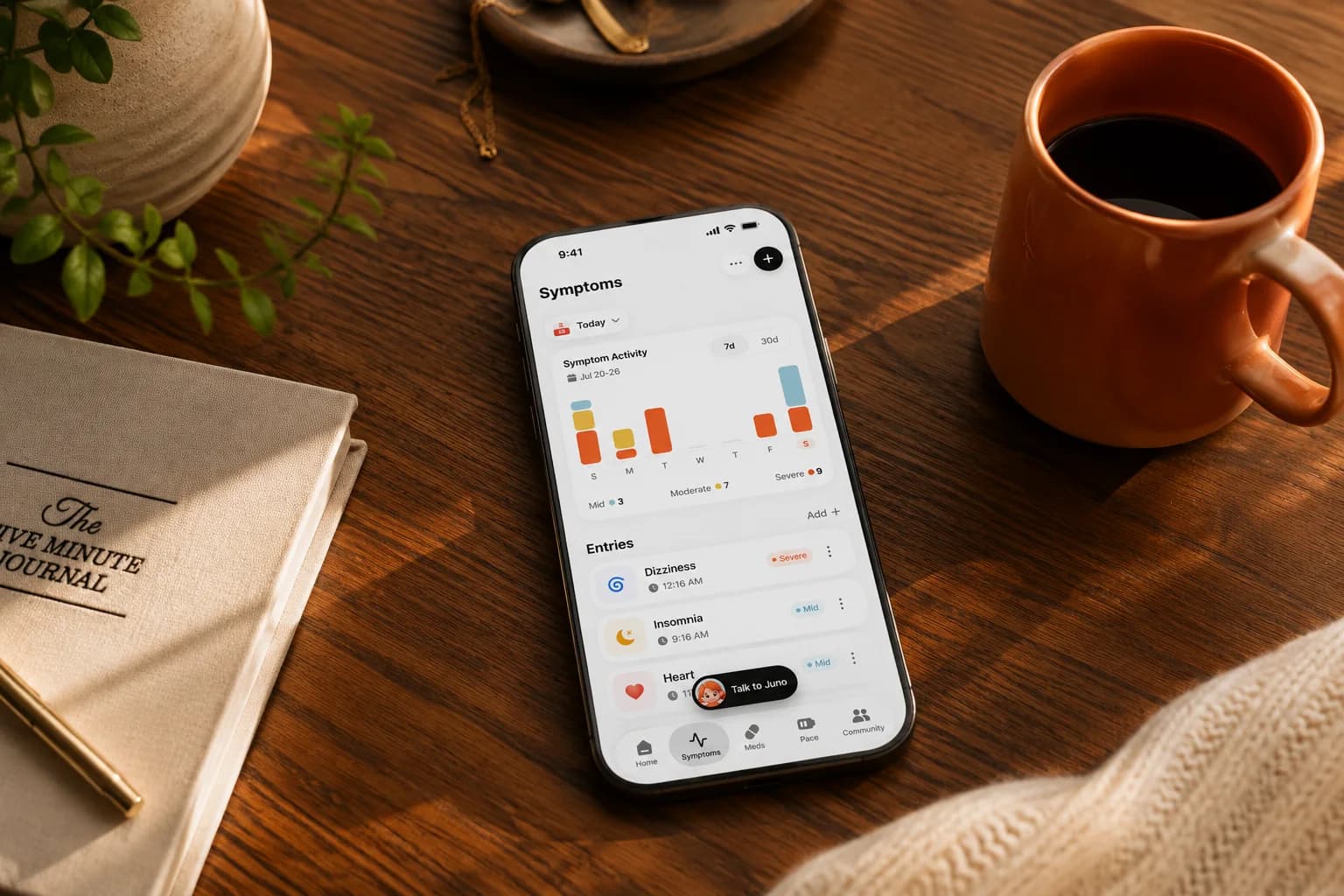
Instead, Juno lets you check in through normal text or voice when something happens. Those small updates can gradually create a clearer record of your symptoms, energy, activities and changes over time, without expecting you to sit down and reconstruct everything later.
Before a doctor's appointment, that scattered information can then become something much easier to understand and talk about.
The point is not to track every second of your life. It is almost the opposite.
It is about having somewhere to put the information so you do not have to keep carrying the whole story around in your head.
Pacing works in a similar way. It is not about controlling every part of your day or following rigid rules. Some days you will accidentally do too much. Some days your symptoms will worsen for reasons you cannot identify. Sometimes life simply will not fit neatly inside an energy budget.
The aim is just to understand your body well enough that managing it takes a little less guesswork.
Because living with a chronic illness already takes enough energy. Managing it should not have to become another full-time job.
How can I pace a day at a glance?
| Step | Prompt | Example |
|---|---|---|
| Notice | What kinds of activity used energy? | Physical, cognitive, emotional, or social |
| Compare | What happened later? | Stable symptoms, delayed worsening, or extra recovery |
| Adjust | What could create more room? | Shorter blocks, pre-emptive rest, or changing the plan |
This article is for general information only and does not provide medical advice, diagnosis, or treatment. Always talk to a qualified clinician about your own health before changing medication, treatment, or activity levels.
Last reviewed: 2026-08-26
Frequently asked questions
What is an energy envelope and how do I find mine?
The energy envelope represents your sustainable daily energy limit under a chronic illness. To estimate yours, use a 100-point scale where 100 is your pre-illness energy level. Observe your average comfortable capacity over a couple of weeks, aiming to operate at 70 to 80 percent of that limit to prevent post-exertional malaise, as supported by Leonard Jason's studies.
How does pacing differ from standard exercise therapy?
Unlike graded exercise therapy, which pushes patients to gradually increase exertion regardless of how they feel, pacing is about listening to your body. It prioritizes staying within your existing energy envelope. Research from Unity Health suggests that roughly 80 percent of ME/CFS patients find this flexible activity management helpful, whereas graded exertion often triggers severe crashes.
What is sleep maths and how can I stop doing it?
Sleep maths is the exhausting mental habit of calculating exactly how many hours of sleep or rest you need to survive tomorrow's schedule without triggering a flare. You can ease this cognitive load by using the Juno App. She quietly logs your sleep continuity, symptoms, and activities, turning messy daily patterns into clean insights so you do not have to hold the entire picture in your head.
Can I use paper worksheets instead of an app to pace myself?
Yes. Pacing should never feel like a chore. Low-barrier offline alternatives, such as free printable worksheets, are excellent for logging daily activity levels, rest periods, and flares. If you later prefer a conversational approach, the Juno App provides a bad-day friendly way to log your symptoms via text or voice without filling out tedious online forms.
How do I explain my pacing and energy limits to my doctor?
Translate your messy notes into a structured daily summary that focuses on functional impact, specifically what your fatigue stopped or delayed. When you use the Juno App, she helps you consolidate these patterns into a structured PDF summary to share with your specialist, proving that you are staying within your energy envelope to manage symptoms.
What should I do if I accidentally push past my baseline and crash?
Stop immediately, strip away non-essential tasks, and schedule proactive, low-stimulation rest. Pacing is not a rigid set of rules, and flares happen to everyone. Document what changed and use bad-day friendly check-ins to record the crash. This context helps the Juno App identify delayed triggers so you can manage your envelope more gently next time.
Tools that go with this article
Sources
Turn day-to-day notes into a clearer health story
Juno helps you track symptoms through conversation, notice patterns, and prepare a structured summary for appointments. See how Juno works. Download Juno on the App Store.
This article is for general information only and does not replace advice from your own clinician. Juno is a health assistant, not a medical provider.
Last reviewed: 2026-08-12